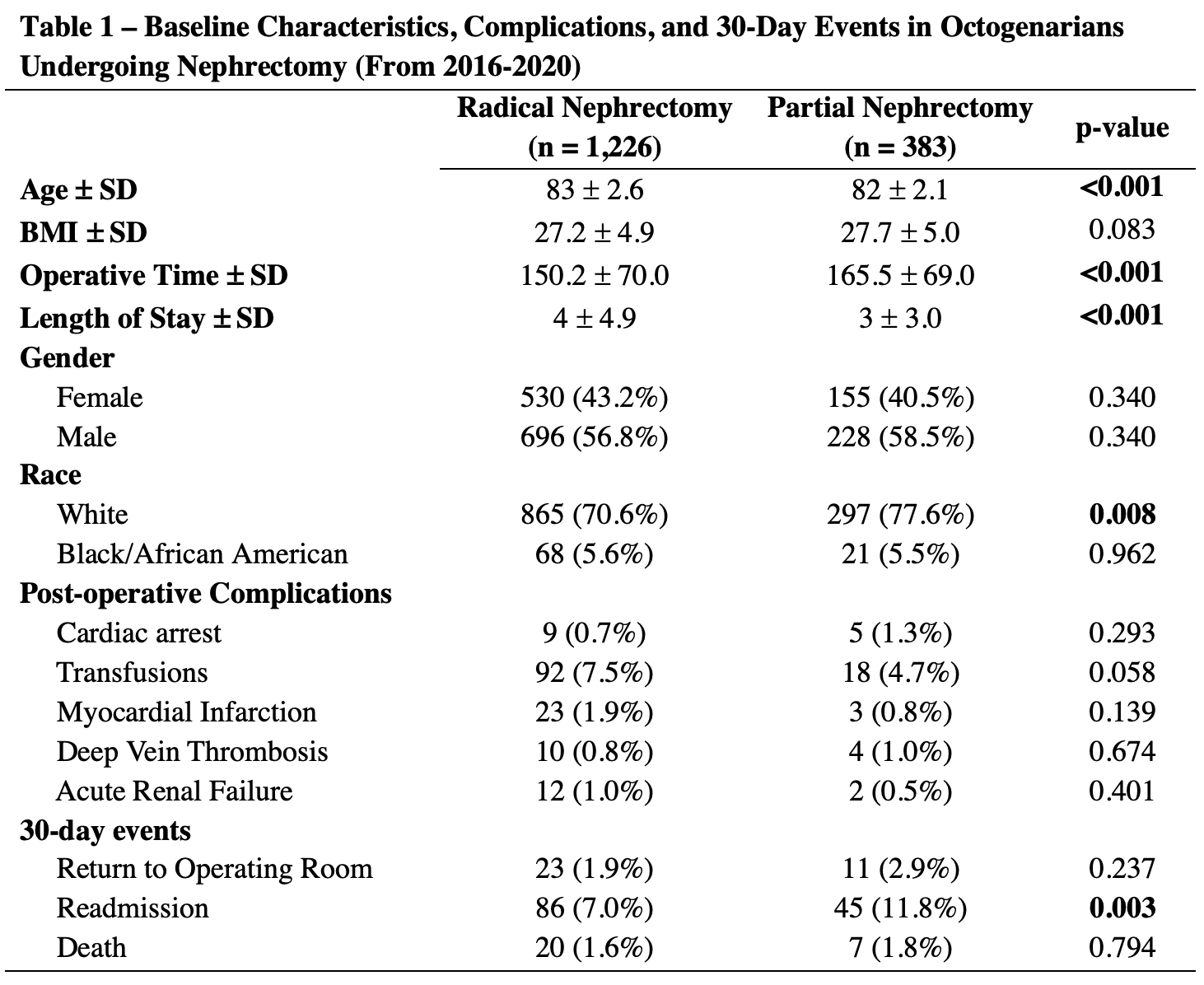
Introduction: Octogenarians with renal masses amenable to partial nephrectomy often receive a radical nephrectomy. This stems from concerns that the renorrhaphy may not heal appropriately and that older patients may not tolerate major complications such as bleeding or urine leak. Using a national cohort, we compared complications and 30-day outcomes in octogenarians who received a partial or radical nephrectomy. Methods: The American College of Surgeons National Surgical Quality Improvement Program (ACS-NSQIP) database was used to identify all subjects 80 years or older who received a minimally invasive partial (CPT: 50543) or radical nephrectomy (CPT: 50545, 50546) from 2016 to 2020. Baseline characteristics, comorbidities, and post-operative complications were compared. Emergent cases, subjects with disseminated disease, and subjects with concurrent procedures were excluded. Chi square analysis and student t-tests were used to analyze categorial and continuous variables, respectively. Results: We identified 1,609 nephrectomies of which, 1,226 (76.2%) were radical and 383 (23.8%) were partial. Those who underwent partial nephrectomy were younger (82 years old vs. 83 years old, p < 0.001). A similar proportion of men (58.5% vs. 56.8%, p = 0.34) and women (40.5% vs. 43.2%, p = 0.34) were seen in each group, and there was no difference in BMI (27.7 vs. 27.2, p = 0.08). Operative times were longer (165.5 mins vs. 150.2, p <0.001) but length of stay was shorter (3 days vs. 4 days, p < 0.001) in the partial nephrectomy group. No differences were seen in post-operative complications. Octogenarians who underwent a partial nephrectomy were readmitted at higher rates (11.8% vs. 7.0%, p = 0.003); however, there was no difference in reoperative rates (2.9% vs. 1.9%, p = 0.24) or mortality (1.8% vs. 1.6%, p = 0.79). Conclusions: Readmission rates in octogenarians who received a partial nephrectomy were higher than those who received a radical nephrectomy; however, no other differences in adverse events were seen. Therefore, we should consider expanding the use of partial nephrectomy in this age cohort. Future studies are needed to explore surgeon parameters and oncological characteristics. SOURCE OF Funding: None