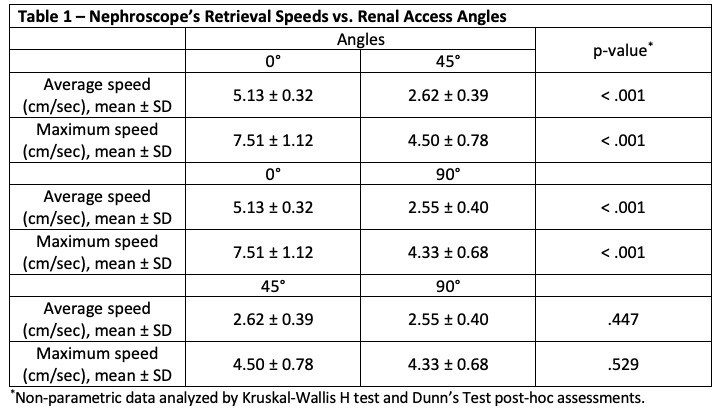
Introduction: The vortex effect (VE) is widely utilized in mini-percutaneous nephrolithotomy (mini-PCNL), although its physical components are still poorly understood. This study aimed to analyze the influence of different renal access angles (as a surrogate for patient positioning) and nephroscope retrieval speeds on the VE’s efficacy during mini-PCNL. Methods: A Pexiglas™ (KUS®) model was built based on the dimensions of a 15/16Fr mini-PCNL set (Karl Storz®). The flow rate was continuously provided via an automatic pump and calibrated to achieve hydrodynamic equivalence (12mL/sec) to the real equipment. One experiment consisted of retrieving all 30 stone phantoms (3mm diameter) utilizing only the VE. Cumulative time to retrieve all stones was measured. An accelerometer recorded instant speeds every 0.08s, and 3 experiments were performed at each angle (0°, 45°, and 90°). Results: Mean cumulative time was 28.1s at 0°, 116.5s at 45°, and 101.4s at 90°(p < 0.01). We noted significantly higher average and maximum speeds at 0° in comparison to 45° and 90° (p < 0.01); however, differences between 45° and 90° were not statistically significant (Table 1). Conclusions: Increasing the renal access angle negatively impacts the nephroscope retrieval speeds and the effectiveness of the VE, significantly increasing procedure time at higher sheath angles, as it would be seen in prone positioning. SOURCE OF Funding: None.