Consultant Urologist Preeti Urology & Kidney Hospital, Hyderabad, india
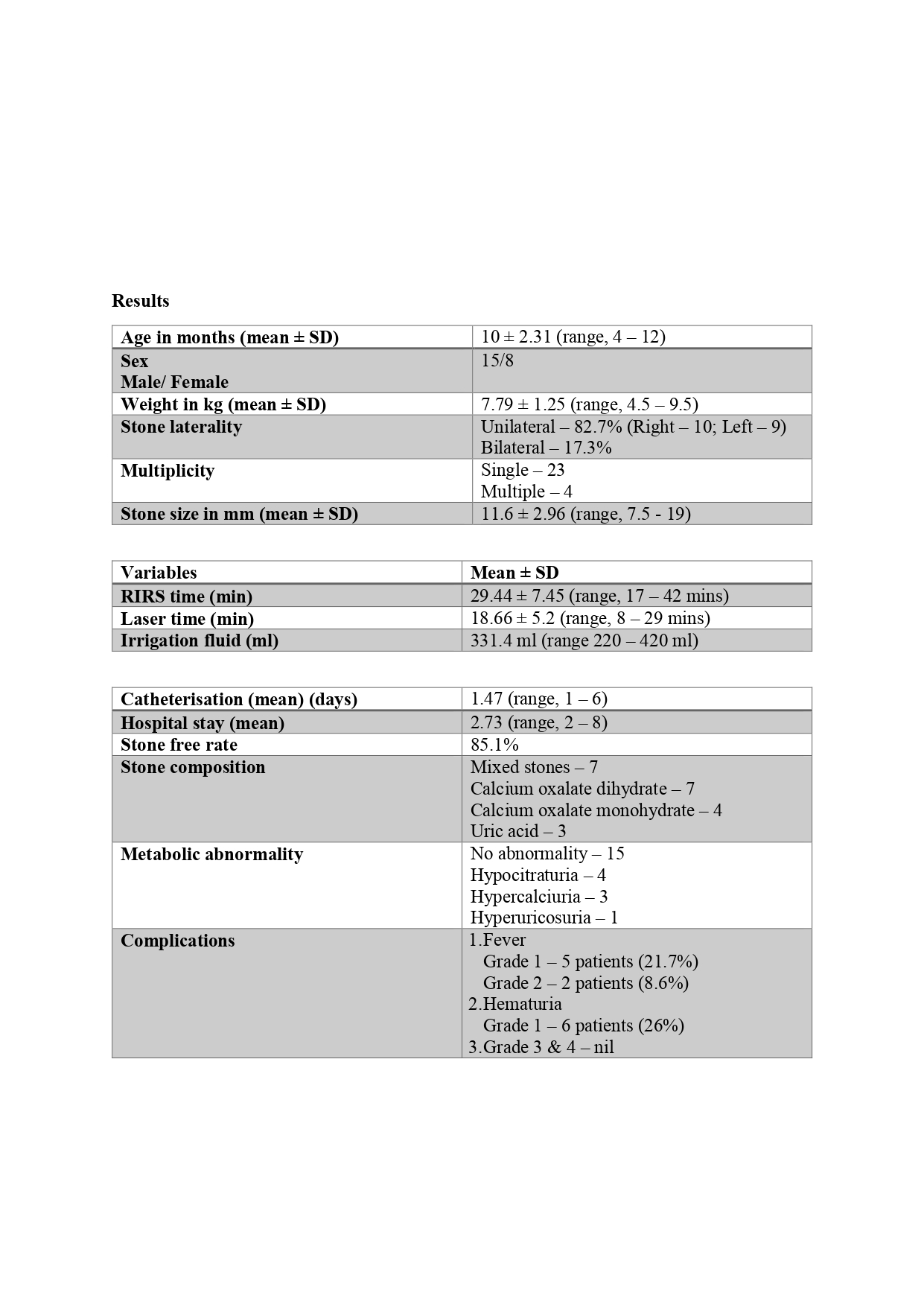
Introduction: Retrograde intrarenal surgery (RIRS) is an established procedure in adults. But there is paucity of literature on the feasibility and safety of RIRS in infantile age group ( <12 months). It is less explored, because of the fear of injury to the small calibre urethra and ureter, and risk of sepsis in infants. In this video presentation we share our technique of doing RIRS safely in infants, and our experience and results Methods: In this video presentation we are showing the steps we follow to do RIRS safely in infants Pre-stenting with 3.5 Fr/ 16 cm Double ‘J’ stent Positioning Meatal calibration Ureteroscopy with 6/7.5 Fr semirigid ureteroscope Passing 2 guidewires (safety guidewire – 0.018” and 0.035”) Manoeuvring upper ureteric kink (commonly seen in infants) with Mertz manoeuvre. Backloading flexible ureteroscope over 0.035” guidewire (no access sheath used) Continuous bladder drainage with suprapubic aspiration in males and infant feeding tube in females. Initial retrograde pyelogram (RGP) Laser lithotripsy settings and technique Basketing small fragment for biochemical stone analysis RGP at the end Inspection of ureter for injuries Double ‘J’ stent (3.5 Fr/ 16 cm) placement Results: Results Age in months (mean ± SD) 10 ± 2.31 (range, 4 – 12) Sex Male/ Female 15/8 Weight in kg (mean ± SD) 7.79 ± 1.25 (range, 4.5 – 9.5) Stone laterality Unilateral – 82.7% (Right – 10; Left – 9) Bilateral – 17.3% Multiplicity Single – 23 Multiple – 4 Stone size in mm (mean ± SD) 11.6 ± 2.96 (range, 7.5 - 19) Variables Mean ± SD RIRS time (min) 29.44 ± 7.45 (range, 17 – 42 mins) Laser time (min) 18.66 ± 5.2 (range, 8 – 29 mins) Irrigation fluid (ml) 331.4 ml (range 220 – 420 ml) Catheterisation (mean) (days) 1.47 (range, 1 – 6) Hospital stay (mean) 2.73 (range, 2 – 8) Stone free rate 85.1% Stone composition Mixed stones – 7 Calcium oxalate dihydrate – 7 Calcium oxalate monohydrate – 4 Uric acid – 3 Metabolic abnormality No abnormality – 15 Hypocitraturia – 4 Hypercalciuria – 3 Hyperuricosuria – 1 Complications Fever Grade 1 – 5 patients (21.7%) Grade 2 – 2 patients (8.6%) Hematuria Grade 1 – 6 patients (26%) Grade 3 & 4 – nil Conclusions: RIRS is a safe and feasible option for renal stone management in infants. It gives a good stone free rate comparable to other modalities. Even though incidence of post-operative fever is higher than in adults, there are no grade 3 & 4 complications encountered. SOURCE OF Funding: Self