MP17-03: The 17-gene Genomic Prostate Score® assay is prognostic for biochemical failure in men with localized prostate cancer after radiation therapy at a community cancer center
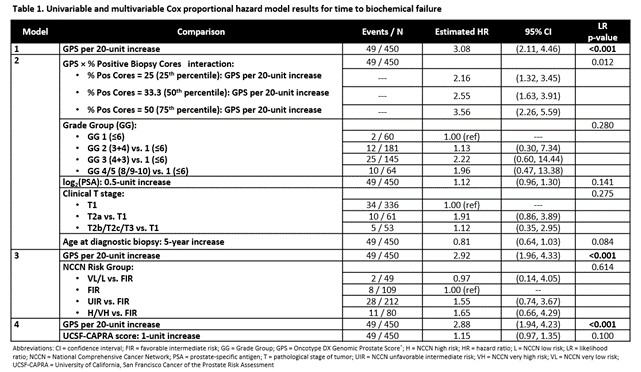
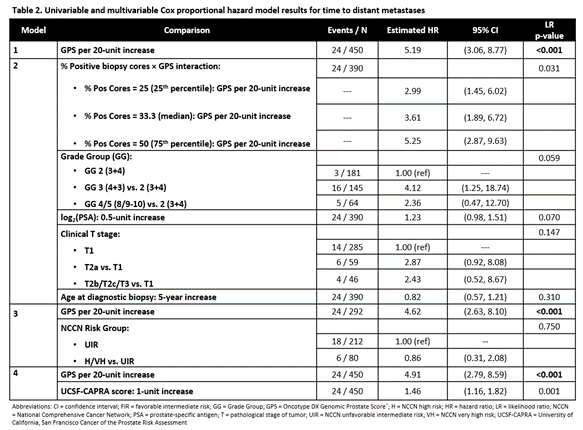
Introduction: Genomic assays, which measure and evaluate biological characteristics from tumor biopsies, can more accurately stratify prostate cancer patients beyond conventional risk categories before definitive treatment. For higher-risk patients, a genomic assay is a valuable tool that can improve the decision- making for multimodal duration therapy. To assess the association between the Oncotype DX Genomic Prostate Score® (GPS™) assay and long-term outcomes in men with localized prostate cancer (PCa) after radiation therapy (RT). We hypothesized that the GPS assay is prognostic for biochemical failure (BCF), along with distant metastasis (DM) and PCa-related death (PCD) in PCa patients receiving RT. Methods: We retrospectively studied men with localized PCa treated with definitive RT from 2010 to 2016. The primary objective was to assess the association between GPS results and time to BCF per the Phoenix criteria; we also evaluated time to DM and PCD. We used Cox proportional hazards regression models for all analyses, with clinicopathologic covariates determined a priori for multivariable modeling. Results: A total of 450 patients (median age = 65 years; 35% African American) met the eligibility criteria. There was a strong univariable association between GPS result and time to BCF (hazard ratio [HR] per 20-unit increase = 3.08; 95% CI: 2.11-4.46; p<0.001) (Table 1), which persisted after adjusting for clinicopathologic characteristics in multivariable analyses. We also observed this association for time to DM (HR=5.19; 95% CI: 3.06-8.77; p<0.001) (Table 2) and PCD (HR=13.07, 95% CI: 4.42-49.39, p<0.001). Race was not a predictor of time to BCF or DM, and the GPS assay was strongly prognostic for all endpoints in African American and White patients. Conclusions: In a community-based cohort, the GPS assay was strongly prognostic for time to BCF as well as long-term outcomes in men given RT for localized prostate cancer. SOURCE OF Funding: Exact Sciences Corporation