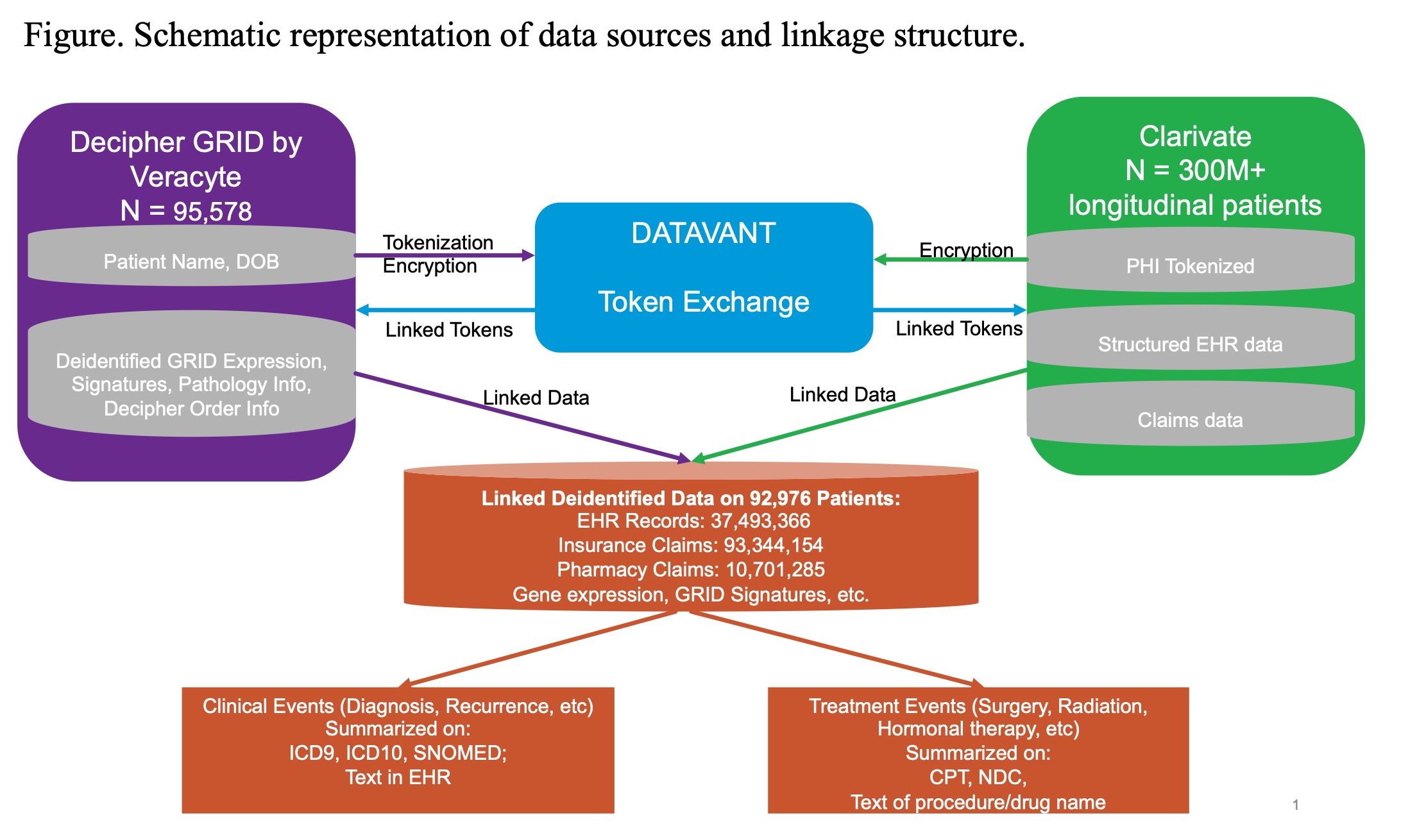
Introduction: We developed a novel linkage between the Decipher prostate genomic classifier (GC) and real-world patient data in the United States across payors and sites of care. Methods: Clinical and transcriptomic data from clinical use of the Decipher prostate GC between 2013-2022 (Veracyte Inc., San Diego, CA) were linked with real-world data aggregated from insurance claims, pharmacy records, and electronic health record (EHR) data (Clarivate, Chandler, AZ). Patients were anonymously linked between datasets by deterministic methods through a de-identification engine using encrypted tokens (Datavant, San Francisco, CA), Figure. The objective of this study was to develop algorithms for identifying prostate cancer diagnoses, treatment timing, and clinical outcomes (biochemical recurrence, BCR, and prostate cancer metastases) in RWD using diagnosis, common procedural terminology (CPT) codes, pharmacy codes, SNOMED clinical terms and unstructured text in the electronic health record (EHR). We compared the accuracy of RWD algorithms using clinical information obtained during Decipher testing as the reference standard. Results: A total of 92,976 of 95,578 (97.2%) patients with Decipher prostate GC were successfully linked to RWD, including 53,871 from biopsy and 39,105 from radical prostatectomy (RP) tests. The median age at Decipher testing was 66.4 years [IQR 61.0, 71.0]. The concordance of prostate cancer diagnoses was 85.0%, including 80.8% for biopsy and 90.7% for RP. Year of treatment was concordant in 98.6% of patients undergoing GC testing at RP, and 87.4% in patients with biopsy GC tests. BCR was identified based on diagnosis code (R97.21 of ICD-10) (96.3%), unstructured text (0.05%) and both in (3.65%). Similarly, metastases were identified based on diagnosis codes (94.9%), unstructured text (1.38%) and both (3.73%). Conclusions: We established the first national-scale linkage of transcriptomic and longitudinal clinical data yielding high accuracy for identifying key clinical junctures including diagnosis, treatment, and early cancer outcome. This resource can be leveraged to enhance understandings of disease biology, patterns of care and treatment effectiveness. SOURCE OF Funding: Veracyte Inc.