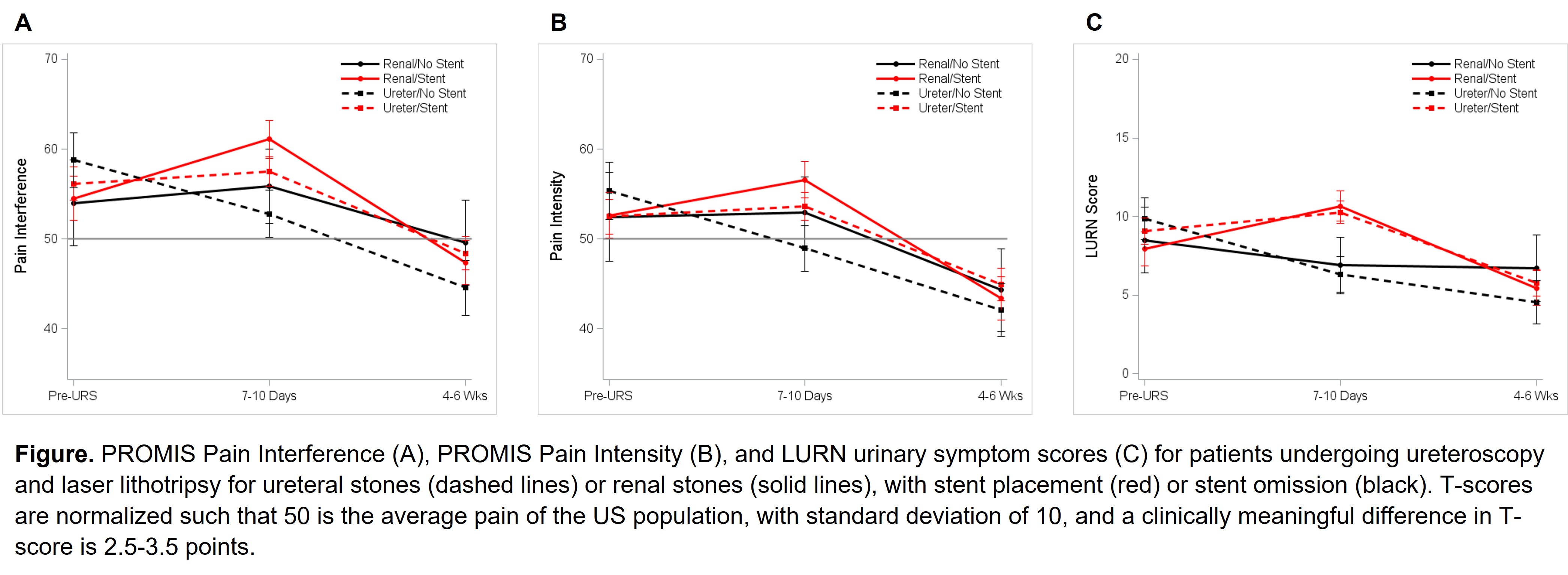
Introduction: Studies of ureteroscopy outcomes have historically centered on efficacy (stone-free rates) and safety (complications). However, the patient’s own subjective experience, including pain and health-related quality of life (HRQOL), are gaining recognition as additional important factors. Empirical data on these are severely lacking. We have previously reported that ureteral stent placement after ureteroscopy increases unplanned healthcare encounters. However, less is known about the impact of stent placement on HRQOL. Methods: The Michigan Urological Surgery Improvement Collaborative (MUSIC) Reducing Operative Complications from Kidney Stones (ROCKS) group launched a patient-reported outcomes (PRO) program in 2021 which includes assessments of pain (PROMIS Pain Intensity and Pain Interference), lower urinary tract symptoms (LURN), and treatment satisfaction (ICIQ). This automated system distributes electronic questionnaires preoperatively and at 7-10 days and 4-6 weeks postoperatively. We compared postoperative day 7-10 (POD7) PROs for stented versus not stented patients based on stone location (renal versus ureteral) with linear regression models adjusting for preoperative score, age, gender, pre-stenting, and stone size. Results: Clinical and PRO data were collected on 338 patients (64% ureteral, 36% renal stones). Overall 251 (74.3%) had a stent placed at the time of surgery. Stented patients had larger stones in both the ureteral (8 vs 6mm, p<0.001) and renal (10 vs 7mm, p<0.001) subgroups. Stent omission in patients with ureteral stones resulted in improved PROMIS Pain Interference (52.7 vs 57.4, p<0.01), PROMIS Pain Intensity (48.9 vs 53.6, p<0.01), LURN urinary symptoms (6.3 vs 10.3, p<0.001), and ICIQ treatment satisfaction (21.1 vs 18.5, p<0.01) at POD7 (Figure). For patients with renal stones, stent omission resulted in improved PROMIS Pain Interference (55.8 vs 61.1, p=0.02) and LURN urinary symptoms (6.9 vs 10.7, p<0.001), without significant differences in PROMIS Pain Intensity (52.9 vs 56.6, p=0.1) or ICIQ treatment satisfaction (20.0 vs 17.6, p=0.07). Conclusions: Stent omission at the time of ureteroscopy was associated with significantly better PROs at POD7 for patients with both ureteral and renal stones. SOURCE OF Funding: Blue Cross Blue Shield of Michigan