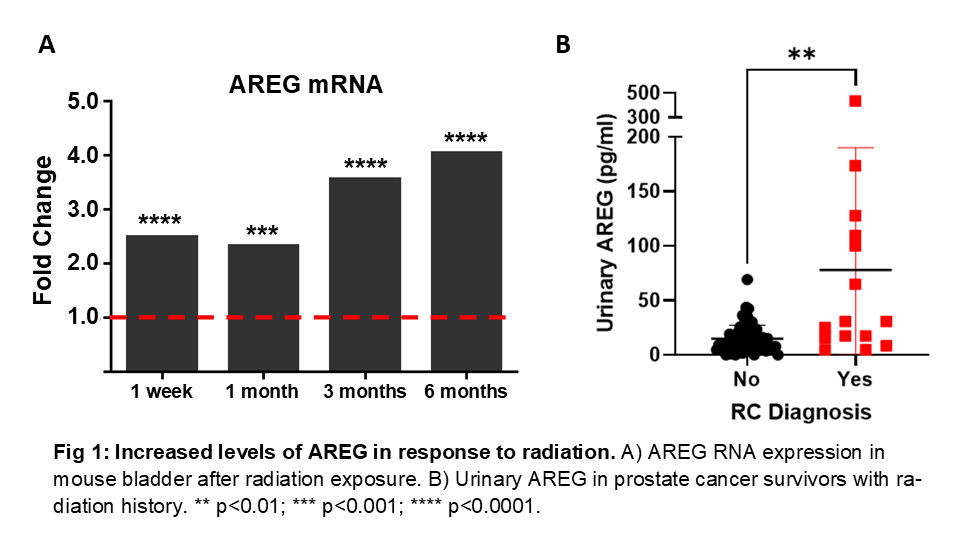
Introduction: Radiation cystitis (RC) is a painful chronic bladder condition that results from radiation therapy for pelvic cancers and for which no safe and effective therapy exists. RC has a long latency; it can take years before We previously developed a pre-clinical model that closely mimics the human condition. We sought to use this model to identify and validate proteins that are altered after RT and that may drive RC. Methods: Female C57Bl/6 mice received a single dose of 40Gy irradiation. Bladders were harvested at 1 week, 4 weeks, 3 months and 6 months after irradiation, RNA was harvested, mRNA sequencing was performed at paired-end 150bp on the Illumina NovaSeq6000 with a target of 30 million reads per sample, and bioinformatics analysis was performed. Findings of the RNA sequencing were validated using qPCR analysis in bladder tissues and human urothelial cells (SV-HUC-1). We subsequently assessed levels of our protein of interest in urine samples from prostate cancer survivors with history of external beam radiation therapy using ELISA. Results: RNAseq analysis identified amphiregulin (AREG) to be significantly increased in mouse bladder tissues in response to irradiation (Fig 1). AREG expression in the bladder significantly increased over time starting at 1-week post-RT and continuing up to 6 months post-RT. AREG is a member of the Epidermal Growth Factor (EGF) family and AREG has been implicated in fibrosis in various organ systems including kidney, skin, heart, lung, and liver. These findings were validated with qPCR. Exposure of human urothelial cells to radiation also resulted in increased AREG RNA and protein expression in a dose dependent manner. In addition, AREG was detectable in the urine of prostate cancer survivors with history of pelvic radiation therapy and was significantly higher in the subset of patients with diagnosis of RC (Fig 1). Conclusions: We have identified increased AREG in bladder tissue and urothelial cells after radiation exposure. AREG has been implicated in pathological tissue fibrosis in various organ systems. As such, AREG may play an important role in mediating radiation cystitis in cancer survivors. AREG may be Further research is needed to determine if AREG could be a novel target to treat and detect bladder fibrosis. SOURCE OF Funding: Research reported in this abstract was supported by NIDDK of NIH by award K01DK114334.