Session: MP23: Stone Disease: Surgical Therapy (including ESWL) I
MP23-07: Impact of Patient Quality of Life between Shock Wave Lithotripsy and Ureteroscopy for less than 10mm Distal Ureteral Stone in Randomized Control Trial; Multi-Central Institutional Study
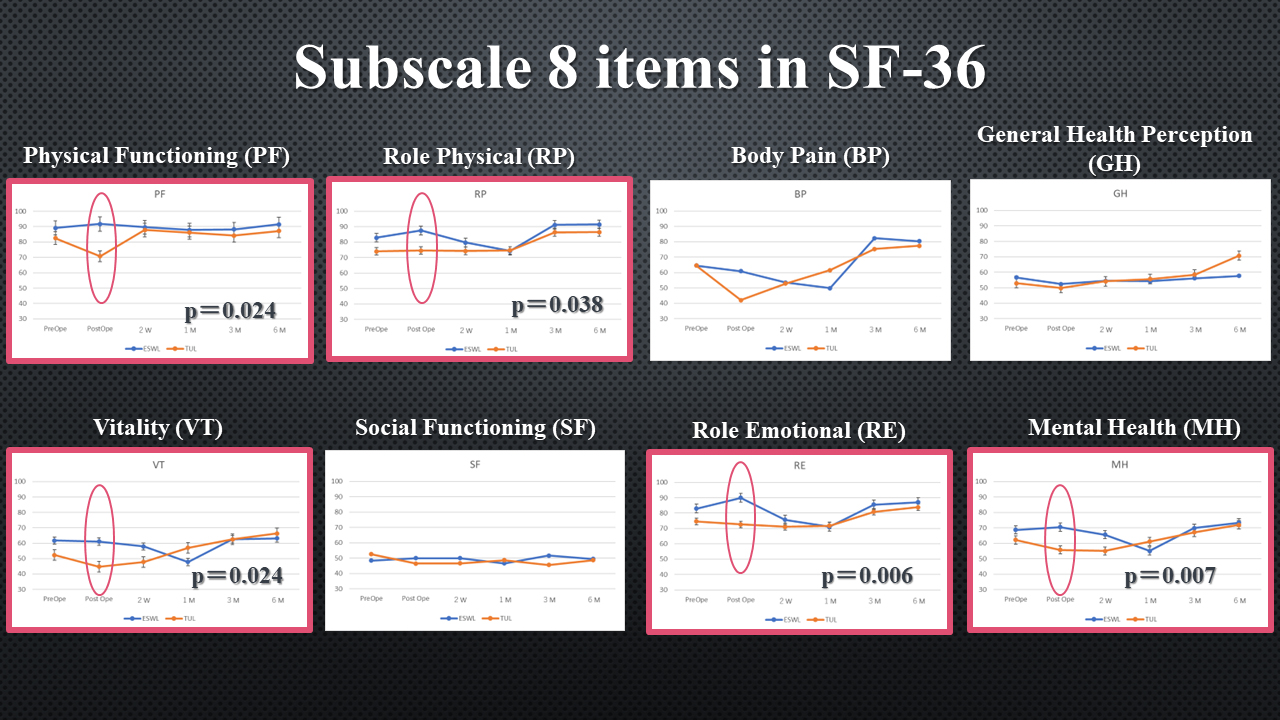
Introduction: European Association of Urology - Guideline recommends the shock wave lithotripsy (SWL) and ureteroscopy (URS) as same level for treatment of less than 10mm distal ureteral stone. Although URS has greater SFR up to four weeks, there is not significantly different between both types of procedures at three months. However, there are few evidence of patient’s quality of life (QOL) in active stone management of distal ureteral stone. Therefore, we aim to evaluate the impact of patient’s QOL between SWL and URS for less than 10mm distal ureteral stone. Methods: We prospectively randomized 50 patients who have a single distal ureteral stone in less than 10mm between June 2016 and September 2021. Every patient after the failure of conservative management for 2-4 weeks were allocated into SWL or URS. We evaluated the patient’s QOL using Short Form (SF)-36 at pre-operation, post-operative 1-day, 1-month, 3-months, and 6-months as primary endpoint. And then, we evaluated the pain-scale, IPSS, surgical outcome, and post-operative complications as secondary endpoint. Results: Although operation time in SWL was significantly longer than URS (mean 90 min vs 47 min, respectively), Pain scale, IPSS, SFR at 2 weeks and 3 months, number of treatment times, duration of hospitalization and post-operative complications were not significantly different. On each item of patient’s QOL in SF-36, Physical Functioning (PF), Role Physical (RP), Vitality (VT), Role Emotional (RE), and Mental Health (MH) on post-operative first day in URS were significantly lower than in SWL (Figure). Totally, although there was not significantly different on Mental Component Summary (MCS), URS was lower than SWL on pre-operative day and post-operative first day on Physical Component Summary (PCS). However, PCS became equivalent level at 2 weeks, 1-month, 3-months, and 6-months, postoperatively. Conclusions: Although operation time in URS was faster for less than 10mm distal ureteral stone, patient’s QOL on PCS in URS was significantly lower than in SWL on post-operative 1-day. However, the patient’s QOL in URS got better 2 weeks later. SOURCE OF Funding: No