Session: MP47: Kidney Cancer: Localized: Surgical Therapy II
MP47-02: Bipolar coagulation versus suture renorrhaphy for hemostasis of tumor bed in laparoscopic partial nephrectomy: prospective randomized comparative study
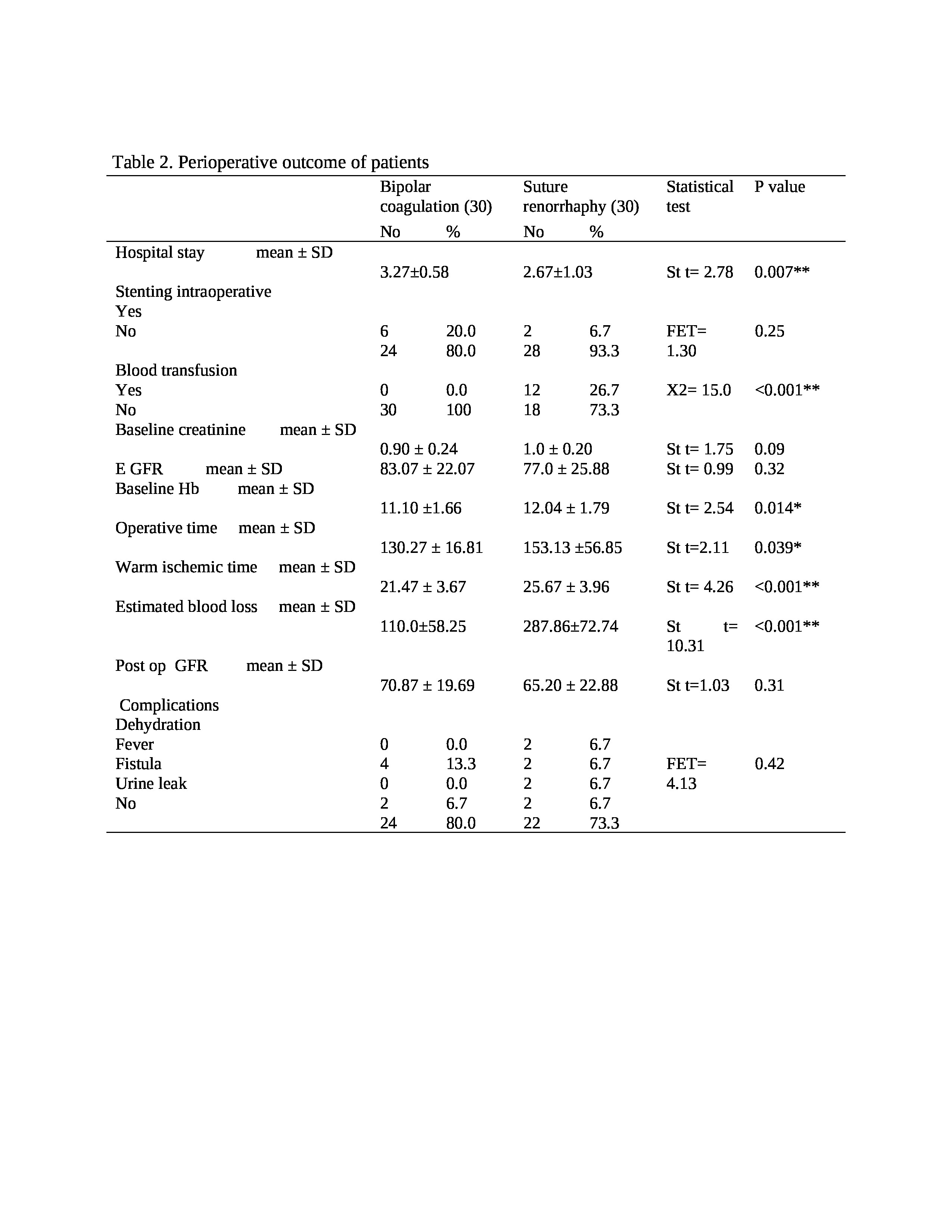
Introduction: Recently, laparoscopic partial nephrectomy has gained popularity since it results in less blood loss, shorter hospital stays, and more rapid recovery than open partial nephrectomy. Various techniques can achieve hemostasis of the tumor bed after laparoscopic partial nephrectomy, including suture renorrhaphy or Bipolar coagulation of tumor bed which is superior to suture renorrhaphy in terms of blood loss, ischemia time, changes in renal function, postoperative hospital stay, postoperative pain. In contrast, some studies reveal that bipolar coagulation has no benefit over suture renorrhaphy . In this study, we compared bipolar coagulation versus conventional suture renorrhaphy in performing stable hemostasis of a tumor bed. Methods: Between December 2020 to April 2022 Sixty cases were eligible. They were randomized into two groups using the sealed envelopes method, the bipolar coagulation group and the suture renorrhaphy group.Inclusion criteria were renal mass less than 7 cm in patients with chronic kidney or end-stage renal disease,T1 polar exophytic renal mass with functioning contralateral kidney, and polar mass in a solitary kidney.Exclusion criteria were patients with central or hilar renal masses or renal masses close to the pelvicalyceal system. Patients were followed up for 6 months.This trail was registered at clinicaltrials.gov with trial registration number NCT05498246. Results: Compared to the suture renorrhaphy group, the bipolar coagulation group had significantly shorter warm ischemia time (21.47 vs. 25.93 minutes), less blood loss (110.0 ±58.25 vs. 287.86 ±72.74 mL), shorter hospital stay (3.27 vs. 2.67 days), less blood transfusion (0% vs. 26.7%, P < 0.001), and less operative time (130.27 vs. 153.13 minutes).No significant differences were observed in the mean age (54.40 vs. 51.47) ,sex: male to female(18/12 vs. 20/10) ,mean RENAL nephrometry score (P value .4 ), mean body mass index (28.33 vs. 28.00) and E GFR (83.07 vs.77.00) between bipolar coagulation group and suture renorrhaphy group. Conclusions: Bipolar coagulation is safer and more efficient for laparoscopic partial nephrectomy than the suture renorrhaphy technique, with less ischemic time. SOURCE OF Funding: None