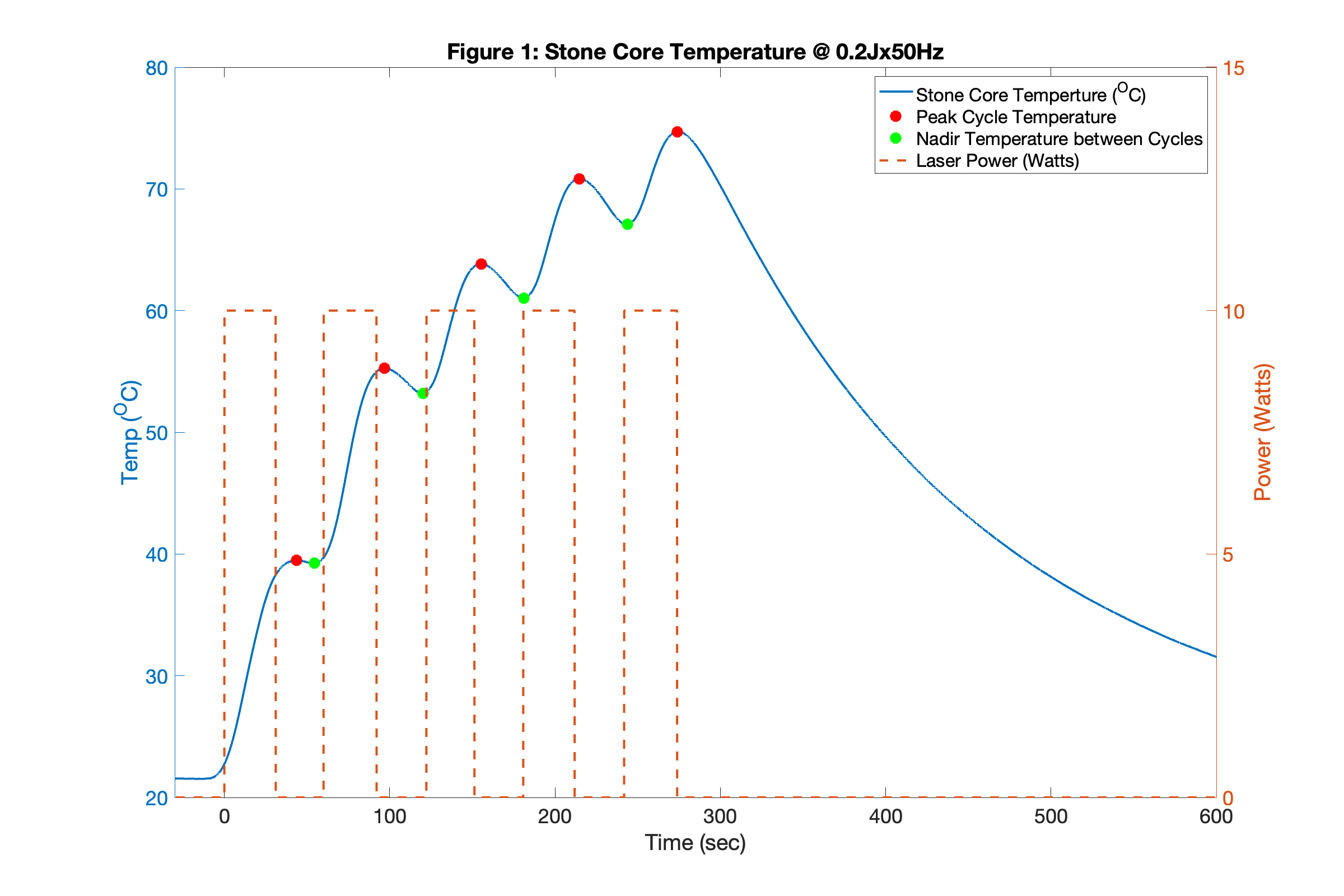
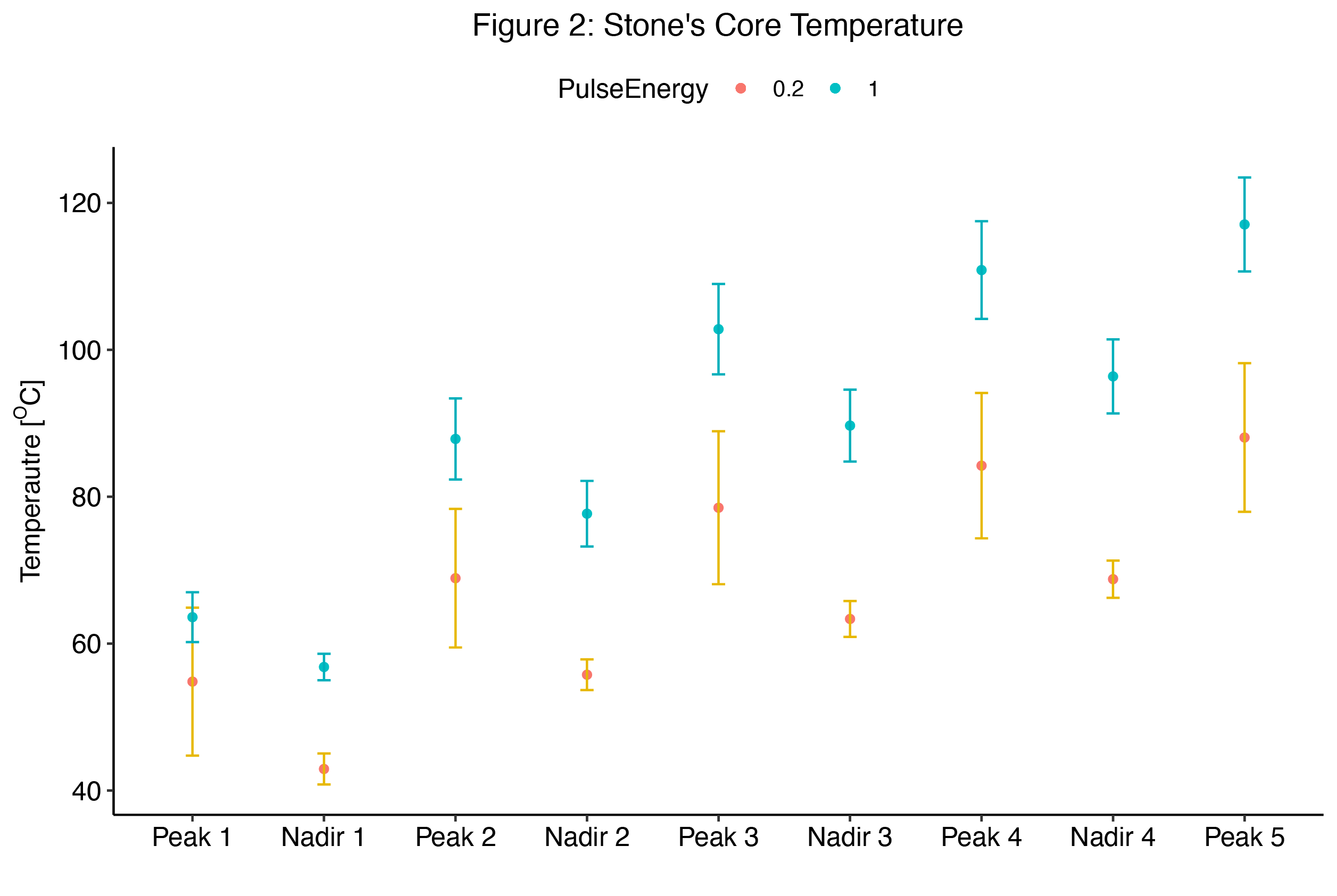
Introduction: Tailoring and optimizing laser settings to achieve desired ablation effects (dusting vs. fragmenting) is challenging, in part due to an incomplete understanding of the mechanism of laser stone ablation. Recently, the dominance of photothermal over photoacoustic effects has been challenged. Quantification of the photothermal effect by measuring the temperature of the stone with absorption of laser energy could help us better understand the contribution of this mechanism of stone ablation. The objective of this study was to measure stone temperature during laser lithotripsy. Methods: A cylindrical BegoStone model with a diameter of 8 mm and a height of 10 mm was molded with a thermocouple along its long axis with the tip at its center. A laser fiber was set perpendicular to the long axis and in contact with the stone surface. While the laser was activated for 30 seconds in an air medium, the fiber was moved by a 3D stepper scanning the surface of the stone. Two 10-Watt laser settings were used – 0.2J x 50Hz (Dusting) and 1J x 10Hz (Fragmentation) for 5 cycles with 30 seconds in between. Additionally, the power outputs of these settings were measured and compared using a power meter. Results: The stone core temperature increased after each cycle of laser activation and did not return to baseline between cycles (Fig. 1). Stone temperature of up to 120 °C was observed. The 1J x 10Hz setting produced greater temperatures, 30°C greater than produced by 0.2J x 50 Hz after the 5th laser cycle (Fig. 2). This significant difference between same power settings can only be partially explained by the inconsistent energy output of the Ho:YAG laser, with up to 15% energy deviation as measured by a power meter. Conclusions: We have developed a tool to investigate temperature elevation in a stone model and shown that laser lithotripsy can substantially elevate stone temperature. Furthermore, the higher temperature found with higher pulse energy deserves additional exploration as temperature may play a role in determining whether dusting or fragmentation dominates stone comminution. SOURCE OF Funding: None