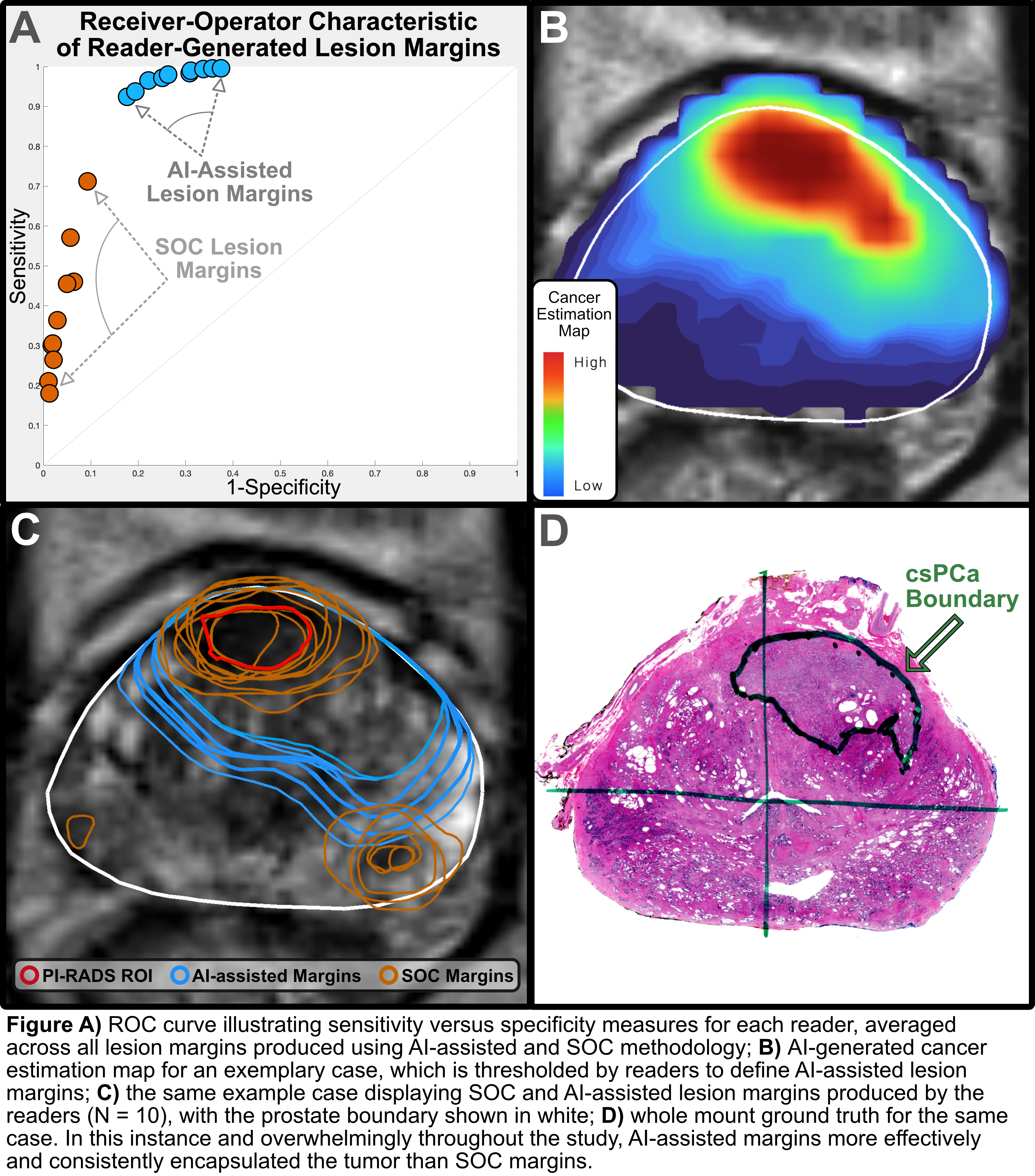
Introduction: Focal therapy (FT) for prostate cancer is gaining prominence as an alternative to whole-gland treatment. FT efficacy relies on predicting disease margins, but their underestimation and patient-specific optimization remain largely unaddressed problems. An artificial intelligence (AI)-based cancer mapping and decision support tool was built using pre-biopsy MRI, targeted biopsy data, and PSA to aid urologists in identifying cancer margins. A reader study was conducted to compare this AI-based software against the standard of care (SOC) in determining the extent of clinically significant prostate cancer (csPCa). Methods: Seven urologists and three radiologists from five institutions with 2 – 23 years of expertise each evaluated 50 prostatectomy cases (total of 1000 reads) Cases were prospectively eligible for FT, with GG 2-3 csPCa, =1 region of interest (ROI), and disease that appeared localized to a single hemisphere or the anterior gland. Each case included T2-weighted MRI, ROI segmentation, and pathology reports with conventional locations. Readers were asked to produce contours on each image that prioritized the inclusion of all csPCa, excluding non-csPCa tissue as a secondary objective. First, readers manually defined margins using all given data (SOC). Then, after =4 weeks had passed, readers produced AI-assisted margins using custom software (iQuest, Avenda Health, CA) [Fig. B]. Margins from each method [Fig. C] were evaluated against WM pathology data [Fig. D] as ground truth. Statistical tests were performed using generalized estimating equations. Results: AI margins had superior sensitivity (97.4% vs. 38.2%, p < 0.0001) to SOC margins in classifying csPCa [Fig. A]. AI-assisted margins also had superior balanced accuracy, i.e. (specificity + sensitivity)/2, to SOC margins (84.7% vs. 67.2%, p < 0.0001). On average, AI-assisted margins completely encapsulated csPCa in 72.8% of cases, compared to only 1.6% of cases with SOC methods (p < 0.0001). Furthermore, the average time spent fell from 3.5 minutes (SOC) to 2.0 minutes (AI-assisted, p < 0.0001). Conclusions: AI-assisted cancer mapping helps address the systematic underestimation of csPCa by SOC methods. This study establishes that AI-assisted margins greatly improve csPCa encapsulation, which could improve oncological efficacy for focal treatments. SOURCE OF Funding: Avenda Health