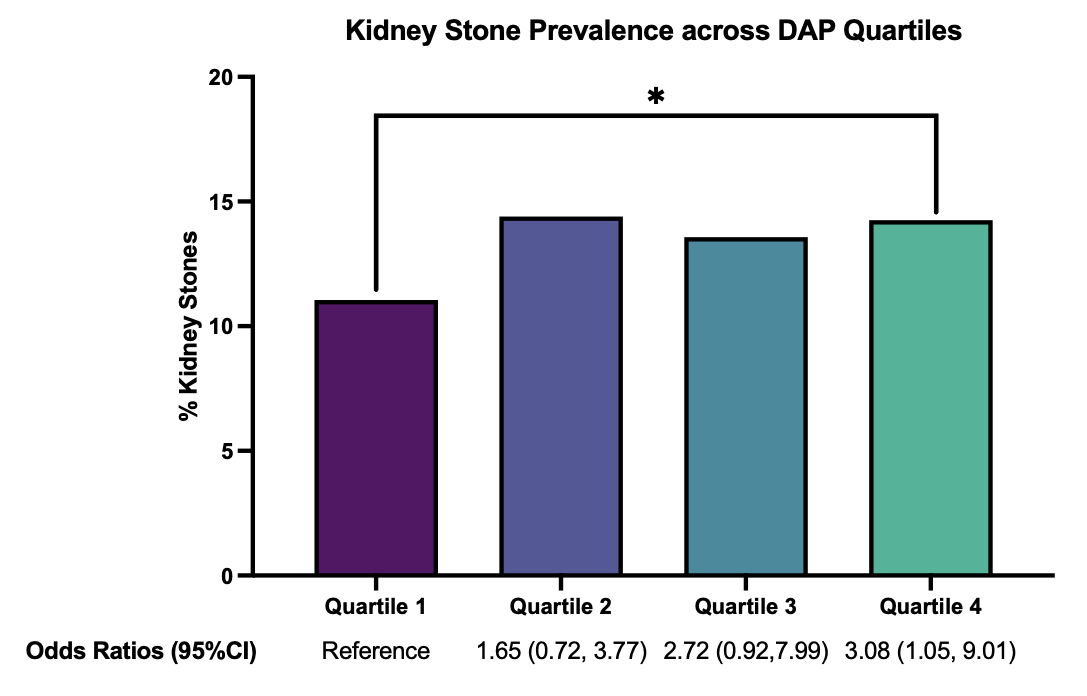
Introduction: Kidney stones pose a significant disease burden within the U.S., where an estimated 10% of adults are affected. While several risk factors have been identified in the etiology of kidney stones (e.g., hydration status, diet, and genetic conditions) the pathogenesis remains to be fully elucidated. Recently, the contribution of environmental exposures in the pathogenesis of adverse urological outcomes has gained attention though data is limited. Organophosphate (OP) insecticides are widespread toxicants, and their use has been associated with endocrine disruption, metabolic dysregulation, and increased risk of chronic diseases. Currently, the association between kidney stone formation and OP exposure is unknown. The purpose of this study was to investigate the relationship between OP exposure and kidney stones. Methods: Data for nationally representative U.S. cohort of 2373 individuals was leveraged from the National Health and Nutrition Examination (NHANES) Survey, annually conducted, population-based cross-sectional study. Trained individuals collected biological specimens via blood and urine draws, and sociodemographic data via in-person questionnaires. Urinary measurements of dialkyl phosphates (DAPs) were used as surrogates for OP exposure. Kidney stone history was evaluated based on questionnaire data, where individuals with kidney stones responded “yes” to either ever having kidney stones, or passed a kidney stone within the last year. Chi-square, ANOVA and multivariable, weighted logistic regression were used to analyze the relationship between DAP exposure, sociodemographic variables, and history of kidney stones. Results: Stratification of total urinary DAPs by quartiles revealed a significant increased odds of kidneys stones in the fourth quartile compared to the first quartile (Q2 OR=1.65 95%CI [0.72,3.77], Q3 OR=2.72 95%CI [0.92,7.99], Q4 OR=3.08 95%CI [1.05,9.01]. Conclusions: Our study represents the first evaluation of OP exposure on risk of kidney stone formation, and these preliminary results suggest a potential role for OP exposure in the pathogenesis of kidney stone formation. Future studies are warranted to validate these findings, and to investigate potential mechanisms underlying these associations. SOURCE OF Funding: No funding