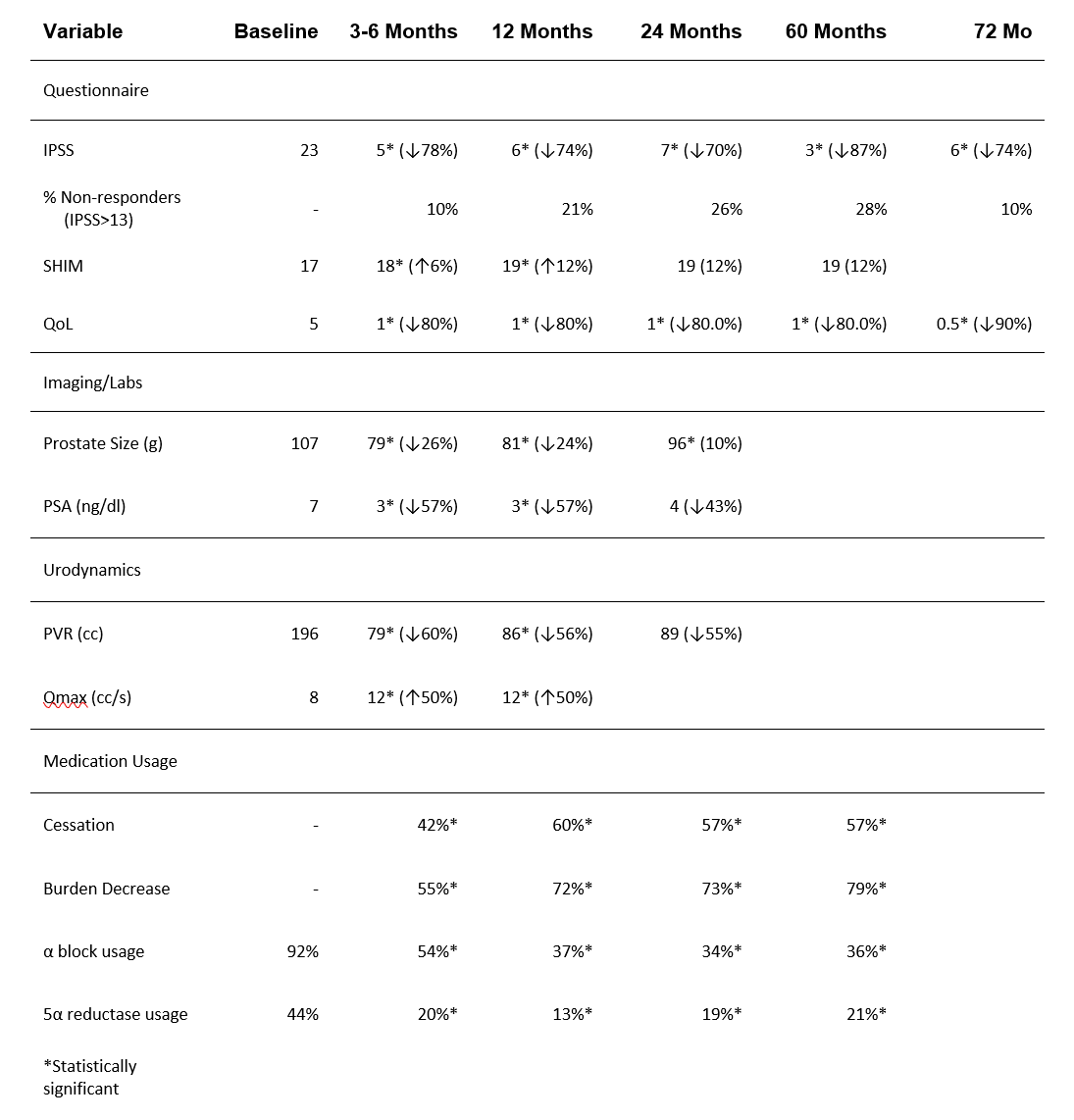
Introduction: To evaluate and expand upon the effectiveness and safety profile of PAE in treating BPH with LUTS or urinary retention. Methods: 1000 patients underwent PAE for either BPH with LUTS or urinary retention from January 2014 to September 2022. Mean patient age was 70.2 ± 9.5 years, mean prostate volume was 107.2 ± 65.1 g, median pre-procedure IPSS, SHIM and QoL scores were 23 (IQR 18-28), 17 (IQR 10-21) and 5 (IQR 4-6), respectively. Mean PVR was 195.6 ± 232 cc, mean PSA was 6.6 ± 6.9 ng/dl, and mean Qmax 8.0 ± 4.2 cc/s. 100 individuals were indwelling catheter dependent at time of PAE with an average of 127.6 days of catheter dependence prior to PAE. 781 individuals reported BPH medication usage. Patient evaluation occurred at 3-6, 12, 24, 60 and 72-month (mo) intervals post PAE. Adverse events were recorded using the Clavien-Dindo (CD) classification. Two-tailed p < 0.05 was considered significant. Results: Median follow up was 1027 days. 63.4% of patients had 3 months or greater follow up. Median IPSS of baseline catheter independent individuals decreased to 5, 6, 7, 3, and 6 at 3-6, 12-, 24-, 60- and 72-months post PAE, respectively (all p<0.01). Percent of non-responders (IPSS>13) are included in the table. Median SHIM, mean prostate size, mean PVR, mean PSA and mean Qmax data is displayed in the table. Average time to indwelling catheter independence was 25.9 days following PAE. At 3 months post PAE 29% (21/73) of individuals were catheter dependent who ultimately achieved catheter independence. 67 patients (6.7%) have required a second procedure for recurrent LUTS; 10 underwent a second PAE. BPH medication cessation, decreased medication burden, and # of individuals on a-blockers of 5a reductase inhibitors is reported in the table. Self-limited frequency, urgency, and dysuria (CD grade I) postoperative symptoms occurred in 33.5% of patients. Complications of non-target embolization, urosepsis, and TIAs were seen in 3 patients each. Conclusions: PAE is a clinically effective procedure for patients LUTS and urinary retention secondary to BPH with great short-term to midterm results. Long-term outcomes including maintained LUTS relief and significant improvement in QoL continue to be promising. SOURCE OF Funding: None