Session: MP76: Benign Prostatic Hyperplasia: Surgical Therapy & New Technology IV
MP76-17: Successful Outcomes in Acute Urinary Retention (AUR) Patients Treated with the Prostatic Urethral Lift (PUL) are Associated with Earlier Intervention
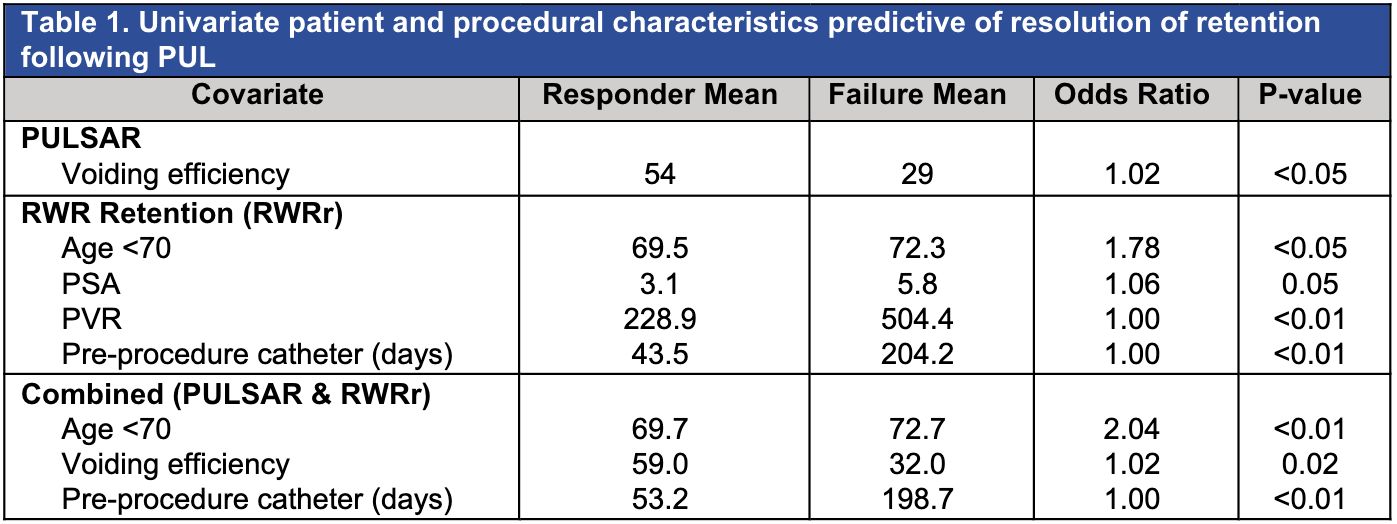
Introduction: AUR represents a subset of difficult patients with BPH-LUTS who require rapid restoration of voiding. Shifting to a day case procedure such as PUL with demonstrated safety and efficacy in AUR patients, may accelerate treatment pathways without compromising patient outcomes. As such, appropriate selection criteria are desired to help urologists better gauge how AUR patients may respond to PUL. Here, we examine patient and procedural characteristics that underpin treatment success in AUR patients who underwent PUL. Methods: A logistical regression model was constructed to evaluate factors associated with outcomes predicting success following PUL (i.e., catheter and surgery free at 12 months). Covariates for subjects in the PULSAR study (single arm PUL in AUR; n=51) as well as retention patients in the real-world registry (RWRr; n=388) included age, prostate volume, proxies of BPH disease severity (IPSS, IPSS QoL, Qmax, PSA, PVR), medical history (duration of catheterization), and procedural details (implants placed, procedure time, voiding efficiency). Results were reported as odds ratio point estimates with statistical significance quantified using chi-squared tests. Results: After PUL, 73% of PULSAR subjects were catheter and surgery free at 12 months with success associated with higher voiding efficiency during the perioperative period. Slightly higher catheter-free rates (80%) were seen in RWRr patients and variables that influenced success encompassed age <70 years at procedure, lower baseline PSA, lower baseline PVR, and shorter pre-procedural catheter duration. Logistic regression for the combined PULSAR and RWRr retention groups revealed success associated with procedural age <70 yr and higher voiding efficiency. Stepwise multivariate regression analysis did not reveal any significant associations (Table 1). Conclusions: Advanced age, higher baseline PSA and PVR, and longer pre-procedure catheter durations drive suboptimal PUL outcomes in AUR patients. Voiding efficiencies following PUL may also help to ascertain long-term response after treatment. In men deemed suitable for PUL treatment, these new selection criteria may provide more men in AUR with earlier access to safe and effective BPH surgery. SOURCE OF Funding: Teleflex, Inc.