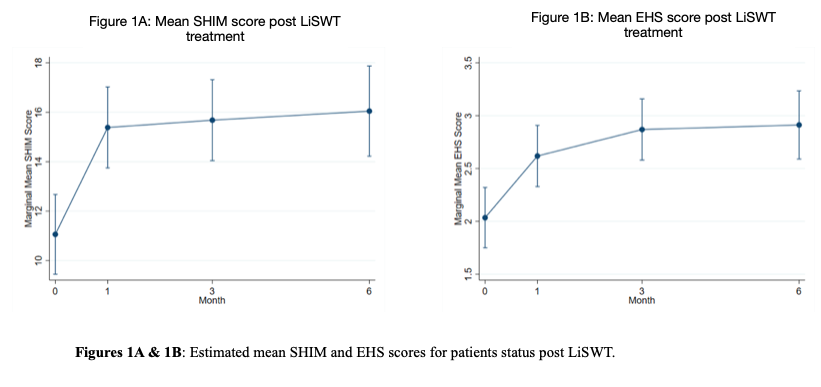
Introduction: Restorative therapies for erectile dysfunction (ED), such as Low-intensity Shockwave Lithotripsy (LiSWT) have generated substantial interest. Despite growing popularity, there are mixed data as to the efficacy of LiSWT and unanswered questions regarding the appropriate patient population for use. This study is a 2-arm stratified, randomized controlled clinical trial to determine whether LiSWT is superior to a sham control for treatment of ED. Methods: A total of 32 patients with mild to moderate ED (SHIM = 8 and = 21) were randomized to LiSWT or sham. In this single-blinded study, patients on the sham arm were allowed to cross over at one month of treatment. Patients underwent twice weekly LiSWT treatments for 3 weeks (6 total) with the Storz® Duolith™ device each delivering 3000 shockwaves at 0.1 mJ/mm2 to the distal penis, base of penis, and crura. Primary outcomes included absolute and relative changes in SHIM score and EHS from baseline to 1, 3, and 6 months post-treatment. Changes in SHIM scores were evaluated with Student’s t-test, while changes in EHS were evaluated using Wilcoxon rank-sum test. Results: Of the subjects randomized to sham, all elected to cross over to LiSWT at 1 month. At 1, 3, and 6 months post-treatment, the mean absolute changes in SHIM scores were 4.2, 4.7, and 5.4, respectively, in the LiSWT group compared to -0.7 in the sham group at 1 month (p < 0.001) (Figure 1A). The percentage improvement in SHIM scores were 51.7%, 54.6%, and 60% at 1, 3, and 6 months post-treatment, respectively (p < 0.001). EHS improved in the LiSWT group with median absolute improvements of 0.6, 0.9, and 1.0 (p < 0.001) (Figure 1B) and percentage improvements 41.1%, 61.1%, and 68.8% over the same time course (p < 0.001). The mean EHS improved from baseline of 2 to 2.9 over the treatment course. No adverse outcomes were reported. Conclusions: Our analysis demonstrates an absolute and durable improvement in SHIM scores and EHS in men undergoing LiSWT for ED at 1, 3, and 6 months post-treatment compared to sham. SHIM score improvements met criteria for previously established minimal clinically significant differences in the erectile function domain of the SHIM (= 4). While limited by population size, the current study is promising for minimally invasive management of ED symptoms. SOURCE OF Funding: No funding to disclose.