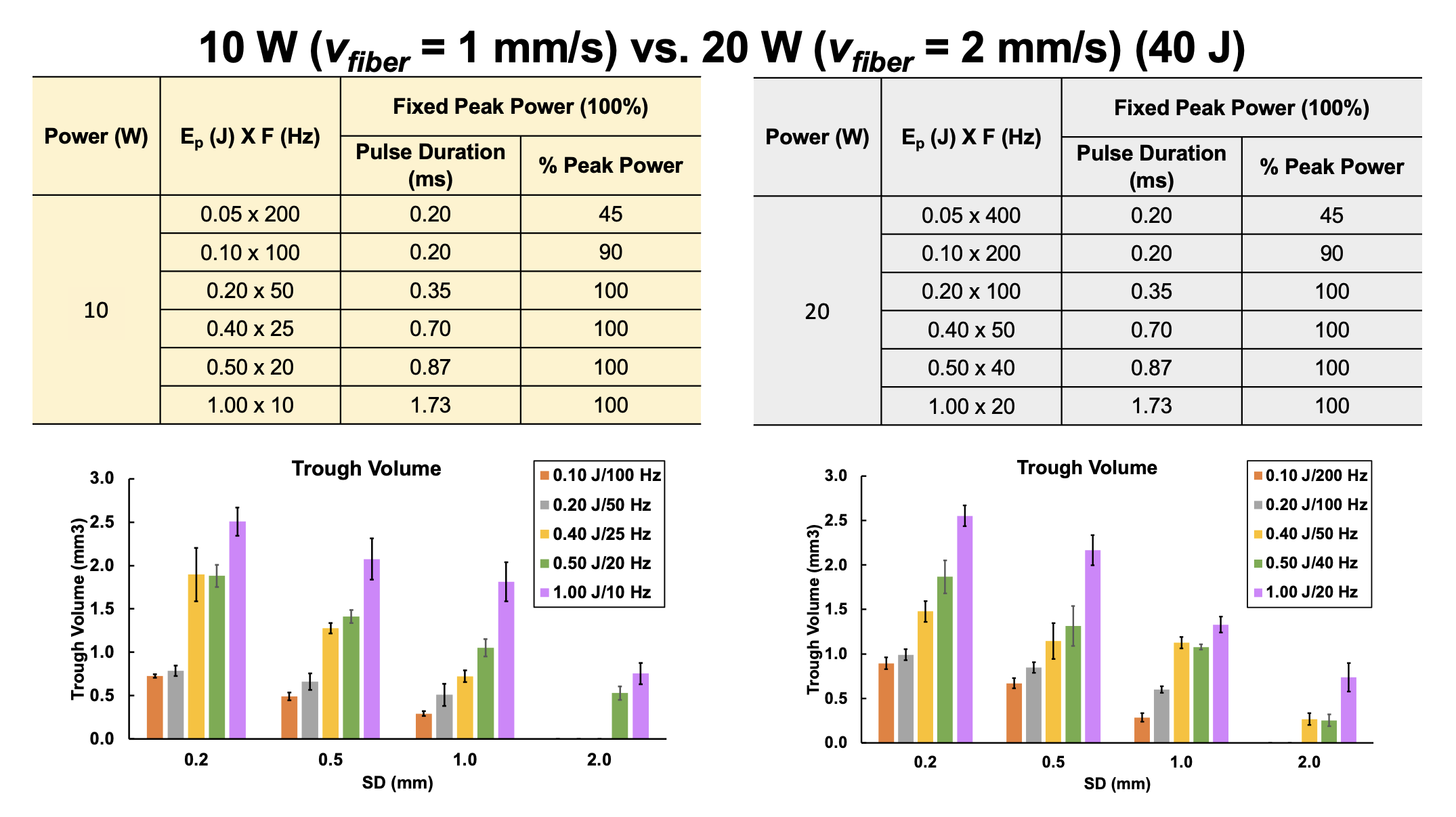
Introduction: Data from Holmium laser studies has taught us that optimal dusting generally require low energy and high frequency settings. In assessing thulium fiber laser (TFL) technology urologists have often relied on “traditional” dusting settings obtained from Holmium laser trials and experiments. However, these two platforms are fundamentally different in their pulse profile and energy (Ep) delivery. Clinical TFL platforms have an energy range of 0.025J-6J and a frequency (F) range of 1Hz-2400Hz. With the seemingly endless combination of settings and lack of scientific evidence to support one over the other, we aim to provide guidance to the practicing urologists and assess the efficiency of the TFL platform in an automated in vitro “dusting model”. Methods: All tests were conducted using an IPG Photonics TLR-50W TFL system and a 200µm fiber on “soft” (5:2) Begostone phantoms. We selected the most popular dusting settings (Figure 1) among endourologists familiar with TFL[1] and tested each combination of Ep and F settings at four different standoff distances (SD) (0.2mm, 0.5mm 1mm, 2mm) and at clinically significant scanning speeds of 1mm/sec or 2mm/sec, under the same total laser energy delivered to the stone (i.e., 40 J). All pulses were adjusted to maximum peak power and the corresponding pulse duration. The laser fiber was scanned in a 15mm straight line with a 3D positioning system across a polished and submerged Begostone surface. Ablation volumes were quantified by optical coherence tomography (OCT). [1] Sierra A, Corrales M, Piñero A, Traxer O. Thulium fiber laser pre-settings during ureterorenoscopy: Twitter's experts' recommendations. World J Urol. 2022;40(6):1529-1535. doi:10.1007/s00345-022-03966-9 Results: The maximum stone ablation was achieved at the combination of high energy and low frequency settings (p < 0.005). Overall, the settings that produced the greatest ablation volume were 1J/10Hz (2.51mm3) and 1J/20Hz (2.55mm3). For the rectangular pulse profile typically used in TFL, as SD increased ablation volume decreased. Conclusions: The most efficient dusting settings for dusting using the current TFL occur at high energy, low frequency, and at a short SD of 0.2mm. Further studies are warranted to compare dusting efficiency produced by these settings using human kidney stones. SOURCE OF Funding: N/A