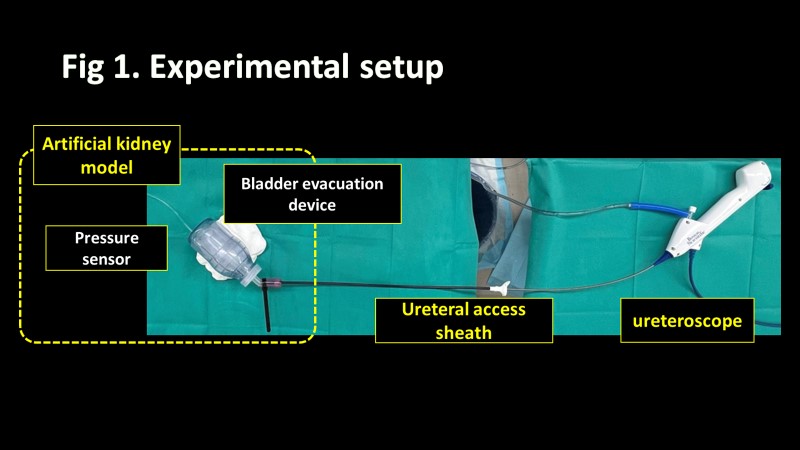
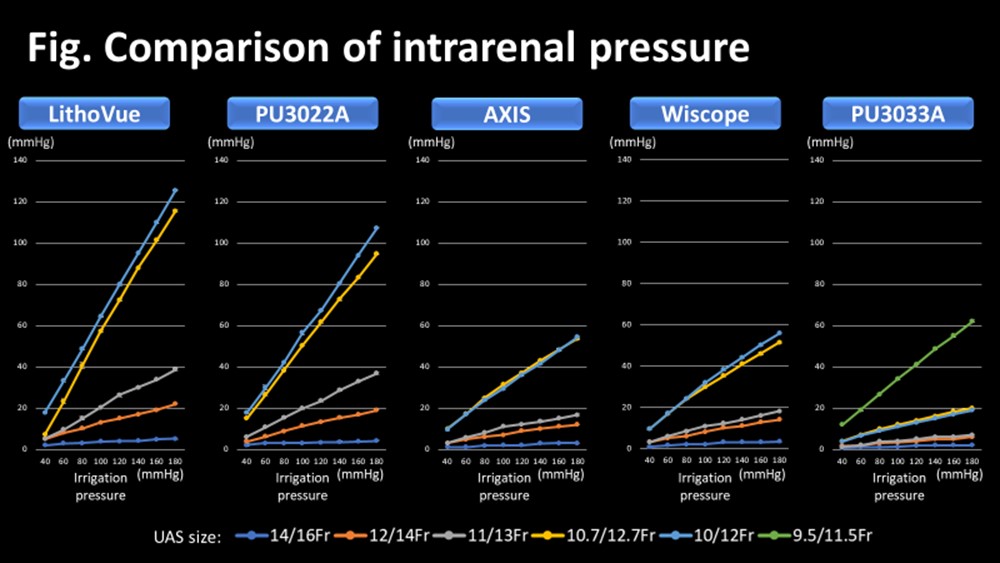
Introduction: Various single-use ureteroscopes (su-URS) have been developed and become commercially available. The difference of scope size could lead to the difference of intrarenal pressure (IRP) during retrograde intrarenal surgery (RIRS). However, no previous study has directly compared IRP among different su-URS. The aim of this in-vitro study was to evaluate IRP during RIRS and compare those among various su-URS. Methods: We created an artificial kidney model with a pressure sensor by using bladder evacuation device. The model was completely closed and the only back flow was on the side of the ureteroscope inside the ureteral access sheath (UAS) (Figure 1). We tested five su-URS (LithoVue, Wiscope, PU3022A, PU3033A and AXIS) with six different UAS (9.5/11.5Fr-14/16Fr). Using the automatic irrigation system, 30 seconds of irrigation was performed at various pressure (40-180mmHg) and steady state IRP was recorded. Six runs were tested per setting. We compared IRP among five su-URS. The diameter of endoscope tip and shaft were also measured and recorded. Results: The diameter of endoscope tip was smallest in PU3033A, while the diameter of other endoscopes was almost similar. The diameter of endoscope shaft was largest in LithoVue, followed by PU3022A, AXIS, Wiscope and PU3033A. Measured IRP was different among su-URS, and endoscopes with larger shaft diameter tended to have higher IRP (Figure 2). Assuming that the cutoff value of IRP for the risk of postoperative sepsis was 30mmHg, the suitable size of UAS was considered to be 12/14Fr or more for LithoVue and PU3022A, 11/13Fr or more for AXIS and Wiscope and 10/12 Fr or more for PU3033A. Conclusions: Our results suggested that the size of endoscope shaft might affect IRP during RIRS, and IRP and suitable size of UAS could be different among various su-URS. SOURCE OF Funding: None.