Session: LBA01: Late-Breaking Abstracts I - Benign
LBA01-15: Prospective Randomized Double Blind Clinical Trial To Compare Holmium Laser Lithotripsy With And Without Moses 2.0 Technology For The Ureteroscopic Treatment Of Nephrolithiasis
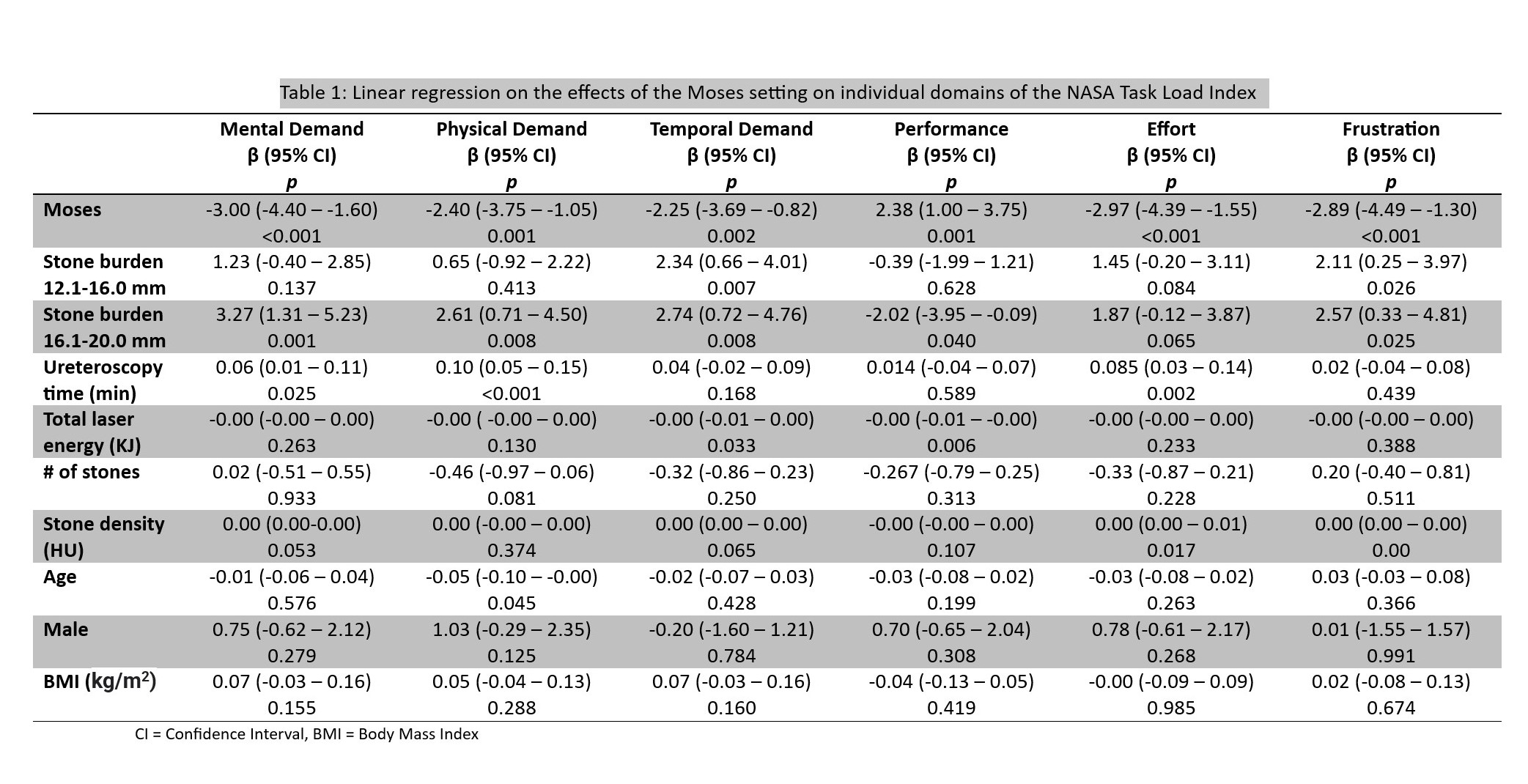
Introduction: The clinical impact of Moses pulse modulation remains debated. We sought to evaluate the potential of Moses 2.0 to reduce operative time for ureteroscopic treatment of nephrolithiasis. Methods: In this multi-institutional, randomized, double-blind clinical trial, 150 patients were randomized to Moses or non-Moses and underwent unilateral ureteroscopy for stones 8-20mm. Stones were treated by attending endourologists with standardized dusting settings. A validated survey (NASA Task Load Index) was completed afterwards. Stents were maintained for 4-10 days, and CT imaging was obtained 6 weeks postoperatively. The primary outcome was to compare total operative times. Secondary outcomes included blinded measures of stone retropulsion, stone-free rate, and surgeon workload. Results: 143 patients were included in the analysis. Demographics and stone characteristics were similar between groups. Moses setting led to shorter ureteroscopy time overall on average, but difference was not statistically significant. (29.5min v 30.7min, p=0.61). When stratified for stone size, total stone burden between 8-12mm demonstrated shorter operative times (-3.5 min, p=0.41) compared to longer operative times for stone burden 12-16mm (+1.0min, p=0.83), and 16-20mm (+9.5min, p=0.13). Amongst 112 patients reaching 6 week follow-up, no difference in stone-free status was seen with and without the Moses setting (42.3% v 38.9%). Surgeons correctly perceived the Moses setting in 57.7% of cases compared to 48.6% of cases without Moses. After using Moses, surgeons experienced less mental burden, physical burden, temporal demand, frustration, and less required effort. Perception of operative performance was higher when using the Moses setting. These findings remained significant on multivariable analysis. Conclusions: No significant differences were seen in total operative time, ureteroscopy time nor stone-free rate. However, use of Moses settings remained a significant predictor across NASA task load domains after controlling for factors that increase surgeon workload during ureteroscopy. SOURCE OF Funding: This study was funded by a grant from the Endourology Disease Group for Excellence.