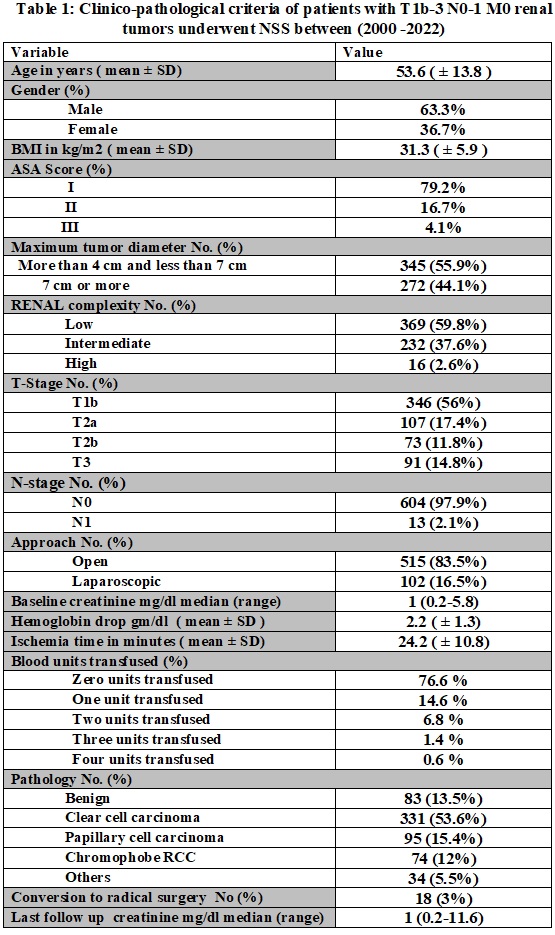
Introduction: To report perioperative safety and long term oncological outcomes of nephron sparing surgery (NSS) in renal tumors more than 4 cm through our experience in a high-volume tertiary referral center. Methods: Our database was retrospectively queried to identify patients with T1b-3 N0-1 M0 renal tumors who underwent NSS at our center between January 2000 till April 2022. Medical records were reviewed to obtain patients' clinical data, tumor criteria and recorded perioperative events. Complexity of renal tumors was assessed using the RENAL scoring model. Our main concern was to record the long term oncological outcome with estimation of cancer specific survival (CSS) and its predictors. Results: A total of 617 patients were included. Baseline clinical and pathological criteria are shown in (Table 1). Maximum tumor diameter was 7 cm or more in 44.1% of patients. As regard complexity, 59.8%, 37.6% and 2.6% of cases were of low, intermediate and high complexity respectively. Open and laparoscopic approaches were used in 83.5% and 16.5% of cases respectively. The mean ischemia time was 24.2 minutes. There was no need for postoperative blood transfusion in 76.6% of cases. Conversion to radical surgery was reported in 3% of cases. After a median follow up duration of 36 months (range 6-236 months), the median postoperative serum creatinine was comparable to median preoperative level, denoting considerable renal function preservation. Out of 495 patients who had long term radiological follow up, Only 19 (3.8%) patients had local recurrence. Out of them, 14 (2.8%) patients were readmitted for radical nephrectomy. The 5-year and 10-year CSS of the study cohort was 93.7% and 87% respectively. Maximum tumor diameter, tumor pathology, operating surgeon and preoperative nodal stage were significant predictors for survival on univariate analysis. After multivariate Cox regression analysis, the nodal stage remained the only independent predictive factor of CSS (HR: 8.6 ; 95% CI: 7.2–12.5 ; p<0.001). Conclusions: Regardless of tumor stage or complexity, our experience demonstrates the feasibility, perioperative safety and acceptable oncological outcome of NSS when technically feasible. Preoperative positive nodal stage is an independent predictor of worse survival. SOURCE OF Funding: No funds were received.