Senior Lecturer Functional and NeuroUrology University Medical Center Utrecht
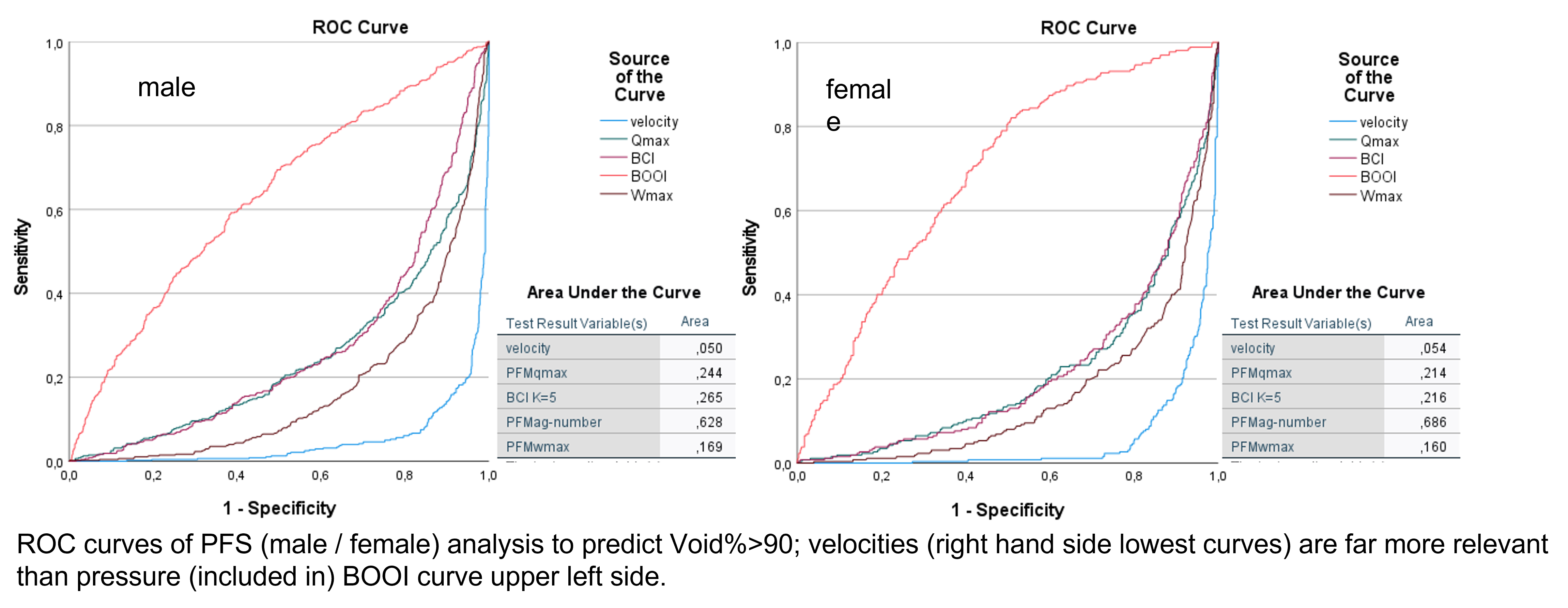
Introduction: Bladder outflow obstruction (BOO) is prevalent in male patients >45y with LUTS but much less in women. Detrusor voiding contraction underactivity (DVC-DU) is (equally?) prevalent in in both sex. BOO affects DVC through 'compensation'; muscle training, to gain force, which is represented in DVC-detrusor- pressure. DVC-muscle shortening velocity (muscle function Hill equation) is less known/studied and is potentially relevant as an element of DVC-DU. We analysed DVC parameters including contraction velocity in a large cohort of adult men and women without BOO. Methods: Patients without relevant neurological or anatomical abnormalities, voiding (pressure flow studies PFS) >100mL and <800mL with PVR <500mL, representative, after ICS (quality) standard UDS, for all usual/possible indications, with 7F double lumen water fill cystometry, were included. All known DVC parameters were analysed and DVC-velocity is calculated: (bladder circumference (based on mL) at begin voiding minus circumference at end) / voiding time (tQ>0). All patients had BOO <3 linPURR (ICS- noOBS). 2488 patients were 63.5y (sd 16.8) men (n1511) 66.3y (15.1) and women (n977) 59.2y (18.3). They voided 359mL with PVR 47mL; void% 89.3. Results: PFS-voided volumes were not different Void% was slightly lower in men (88.6 vs 90.4). Men's Qmax 12.5 mL/s; pdetQmax 43.3cmH2O; BOOI 18.1; and Wmax 12.3W/m2 differed signific. from women Qmax 19.9 mL/s; pdetQmax 25.7cmH2O; BOOI -14.1; and Wmax 13.0W/m2. DVC-velocity was 0.37cm/s in men vs 0.56cm/s (p.000). 58.4% of men had void%100 62.2% of women. The figure demonstrates the relevance of DVC-velocity to predict incomplete voiding, in absence of BOO. Conclusions: Men with LUTS have somewhat higher outflow resistance than women even when they are all within the no BOO -category. Anatomical differences likely the cause. Only a small percentage of all female patients has outflow obstruction (>grade 2) and diagnosing DVC especially in cohorts of female patients (but also in men without BOO) requires a parameter that includes detrusor contraction velocity. Most of the currently available parameters to represent the contraction force or -strength of the DVC include detrusor pressure -with a certain weight- in a mathematical product. If there is no or low grade outflow resistance however, not contraction power (˜pressure), but contraction speed (velocity or (flow)rate) is more important. This is now supported by this analysis showing that, in patients without BOO ( Funding: none