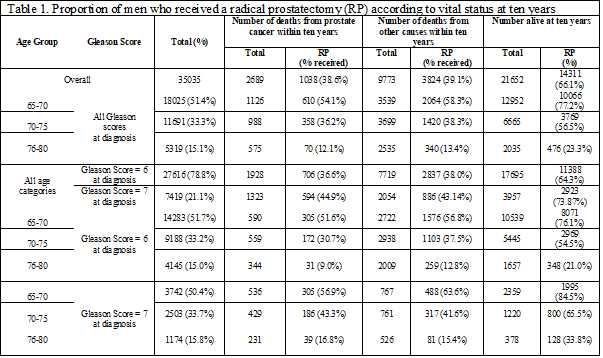
Introduction: In deciding upon radical prostatectomy for a prostate cancer patient, urologists are asked to consider a patient’s life expectancy as well as tumour aggressiveness. NCCN recommends observation or non-surgical management for men with low- or intermediate-risk cancer who have a life expectancy of less than ten years. It is unclear how life expectancy calculated at diagnosis accurately reflects the actual mortality experience. The objective of this study is to determine the proportion of men who are over the age of 65 at the time of surgery who die of prostate cancer versus other causes within 10-years. Methods: We performed a population-based, retrospective cohort study using data from the Surveillance, Epidemiology and End-Results (SEER) program. Our study included 35,035 men with prostate cancer diagnosed between the years 1992 -1997 who were between the ages 60-80 at the time of diagnosis. Results: Of the men in the study, 13,383 (38.2%) died within ten years of diagnosis. Of these, 2,689 (20%) died of prostate cancer and 9,773 (73%) died of another cause (921 missing data). Of the 2689 men who died of prostate cancer within 10-years of diagnosis, 38.6% had a radical prostatectomy. Of the 9773 men who died of another cause within 10-years of diagnosis, 38.6% had a radical prostatectomy. Conclusions: After stratifying by age of diagnosis, the proportions of men who did and who did not have a radical prostatectomy varied little by the actual ten-year mortality experience of the groups. We should either improve our mortality estimation methods for patients being considered for radical prostatectomy or re-evaluate the clinical utility of recommending this as part of the assessment before surgery. SOURCE OF Funding: None