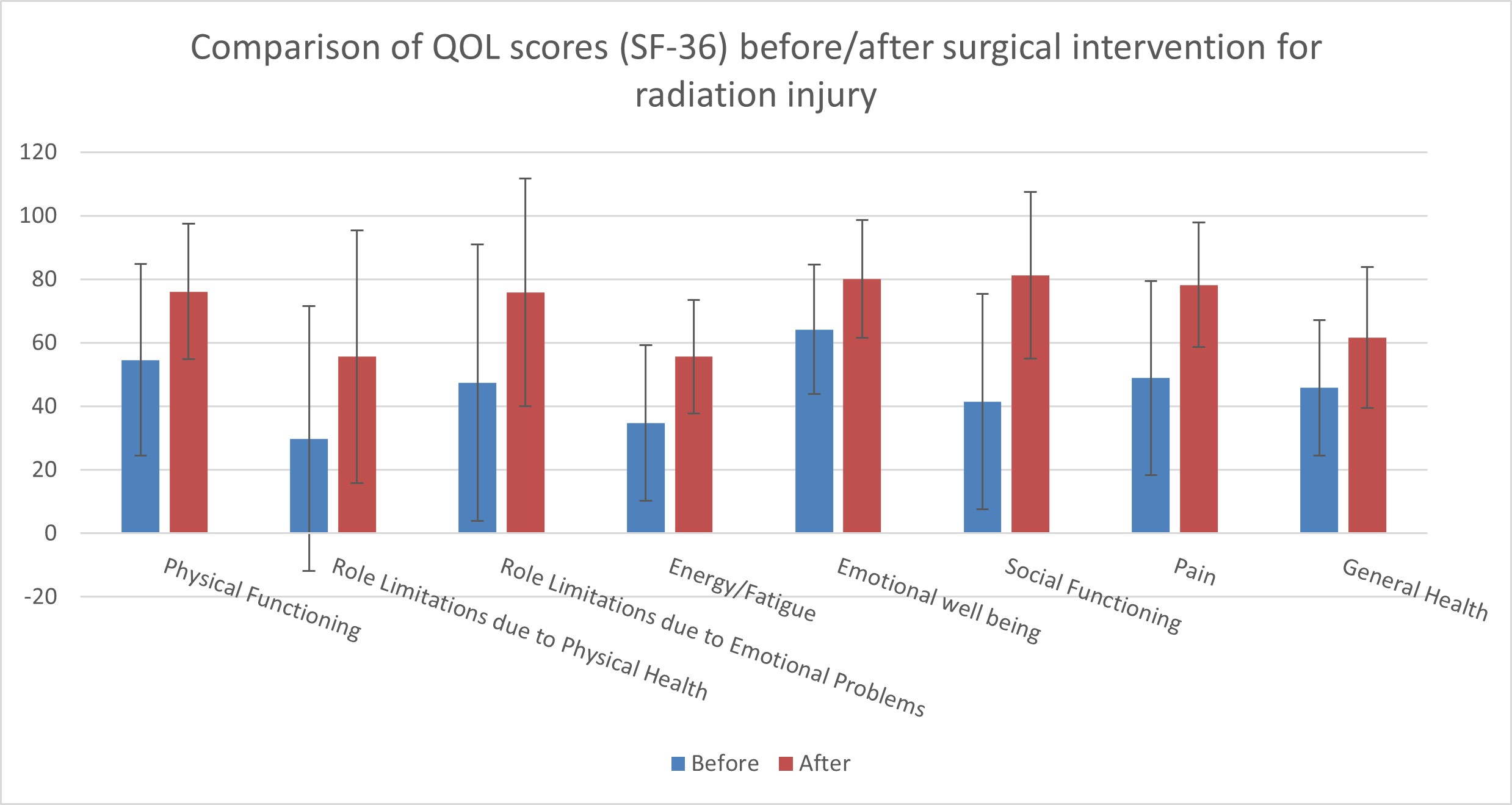
Introduction: The impact of surgical intervention following radiation injury on patient quality of life (QOL) is not well studied. The objective of this study was to evaluate the effect of definitive surgical intervention on health burden and QOL among patients with a history of radiation. Methods: Patients who underwent major intra-abdominal intervention to address radiation injury were included in the study (N=24). A validated 36-item short form (SF-36) survey was used to assess QOL domains (0-100, low-high) pre- and post-operatively. The scores obtained from these surveys were used to assess the difference in QOL before and after intervention across the group and on a per-individual basis (pairwise students-t). Results: Median time from radiation to surgical intervention was 7.6 years. The etiology of radiation injury was urologic in 20(83%), colorectal in 2(8%), gynecologic in 2(8%). In total, 10(42%) patients had fistula and 8(33%) had strictures. In assessment of radiation injury burden on health in the year before surgery vs the year after, there was significantly greater hospitalizations (median 1 vs 0.5), hospitalized days (3.5 vs 0.5), and ER visits (1 vs 0; all p<0.05). There was no significant difference in hospitalizations or ER visits according to injury etiology. Pre- and post SF-36 survey was conducted a median 1.6 months prior to surgery and 5.1 months after. Figure 1. outlines the differences in pre- and post-operative QOL. Mean QOL scores improved in every domain following surgery, including physical functioning (54.6 vs 76.1), role limitations due to physical health (29.8 vs 55.6), role limitations due to emotional problems (47.4 vs 75.9), energy/fatigue (34.7 vs 55.6), emotional well-being (64.2 vs 80.1), social functioning (41.4 vs 81.3), pain (48.9 vs 78.2), and general health (45.8 vs 61.7) (all p<0.05). Per-individual pairwise comparisons were clinically significant except for physical health. Conclusions: Following definitive surgical intervention for radiation induced urinary injury there is a significant reduction in health-related complications and improved QOL across all measured domains. Such information may prove useful in directing earlier intervention and appropriately counseling patients. SOURCE OF Funding: None