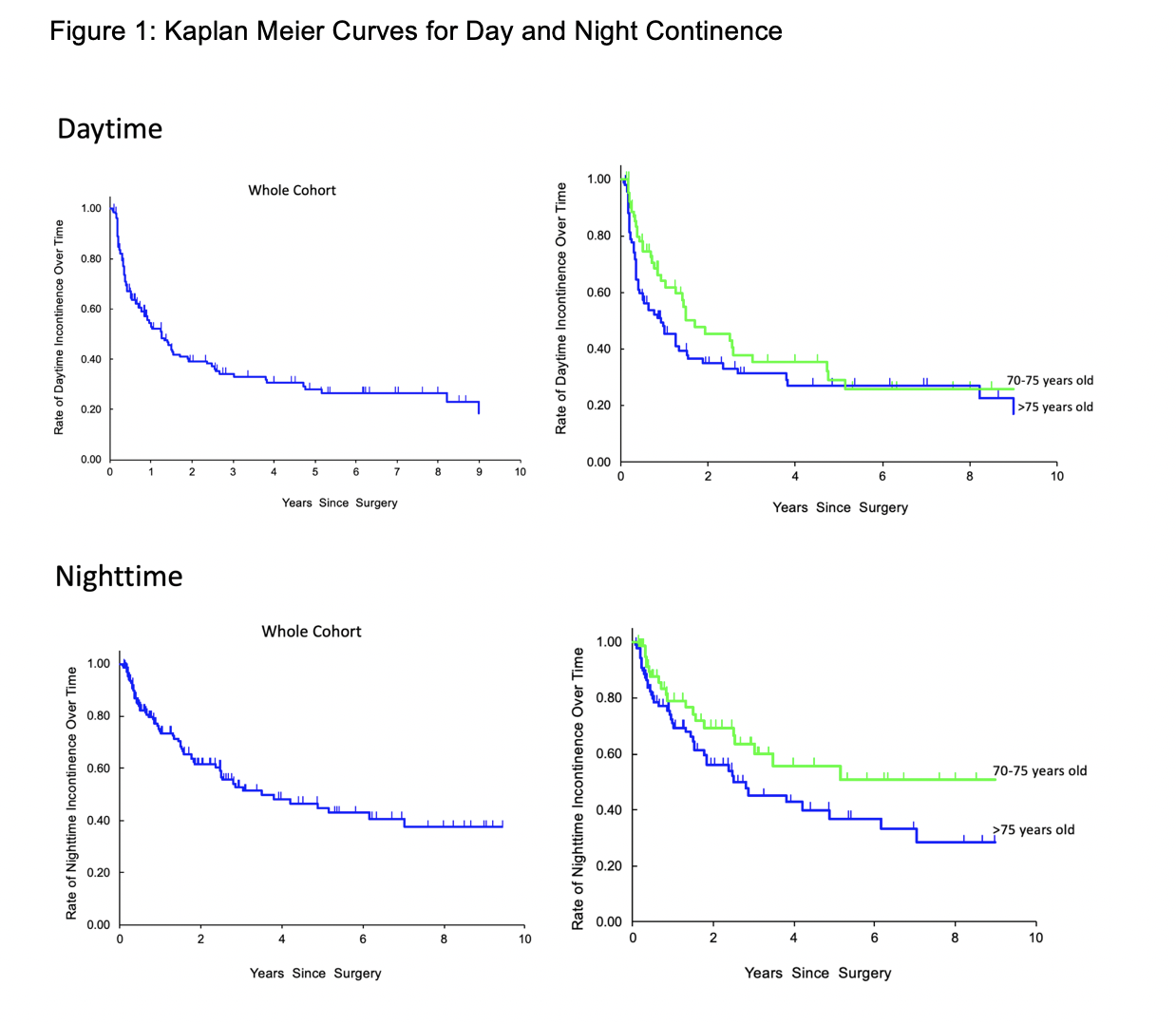
Introduction: Elderly patients who require radical cystectomy (RC) are more likely to undergo an incontinent urinary diversion due to unclear long-term functional outcomes of a continent diversion. Herein, we evaluate the continence outcomes in elderly males undergoing orthotopic neobladder (ONB) diversion after RC using a validated questionnaire. Methods: Using our IRB approved bladder cancer database, we identified male patients, 70 years old or older, who underwent open RC and ONB from 2002 to 2021. Beginning in 2012 the patients completed a validated pictorial pad use questionnaire at each follow-up visit. The questionnaire assessed pad number, size and wetness as well as catheter use. Continence was defined as use of “no pads” or pads that are “almost dry”. Urinary retention was defined as =3 catheterizations/day or a self-reported inability to void without a catheter. Patients with artificial urinary sphincters or less than 6 months of follow up were excluded from the study. Kaplan-Meier curves and cox regression were used to analyze the data. Results: A total of 156 male patients with median age of 74 years (IQR: 72-77) and BMI of 26.7 (IQR: 24.2 - 29) were included. 64 (41%) patient were >75 years old. 42 (27%) patients received neoadjuvant chemotherapy. 71 (45.5%) patients had Charlson comorbidity index (CCI) score of > 2. Fifteen (10%) patients had pathological staging >pT3 and 23 (15%) had pathological nodal disease. At 1 year following the surgery, half of the patients gained daytime continence and 30% gained nighttime continence which increased over the study period. Day and nighttime continence rates were 74% and 68% at 5 years postoperatively (figure 1). Only 13 (8%) patients developed retention over the study period. Patients > 75 years old had worse nighttime continence outcome compared to <75 years old (P=0.07) (figure 1). Multivariate cox regression model including age, CCI, BMI, diabetes, and perioperative chemotherapy did not show any significant risk factor for daytime incontinence, however; age >75 was significantly associated with nighttime incontinence (HR 1.07, P=0.04). Conclusions: Orthotopic neobladder represents a viable option for urinary diversion in selected elderly males undergoing radical cystectomy and age alone should not be considered a contraindication. SOURCE OF Funding: None