MP65-14: Efficacy of polyacrylamide gel (Bulkamid®) injection in patients with Mitrofanoff leakage after continent diversion surgery: a comparison with Macroplastique®
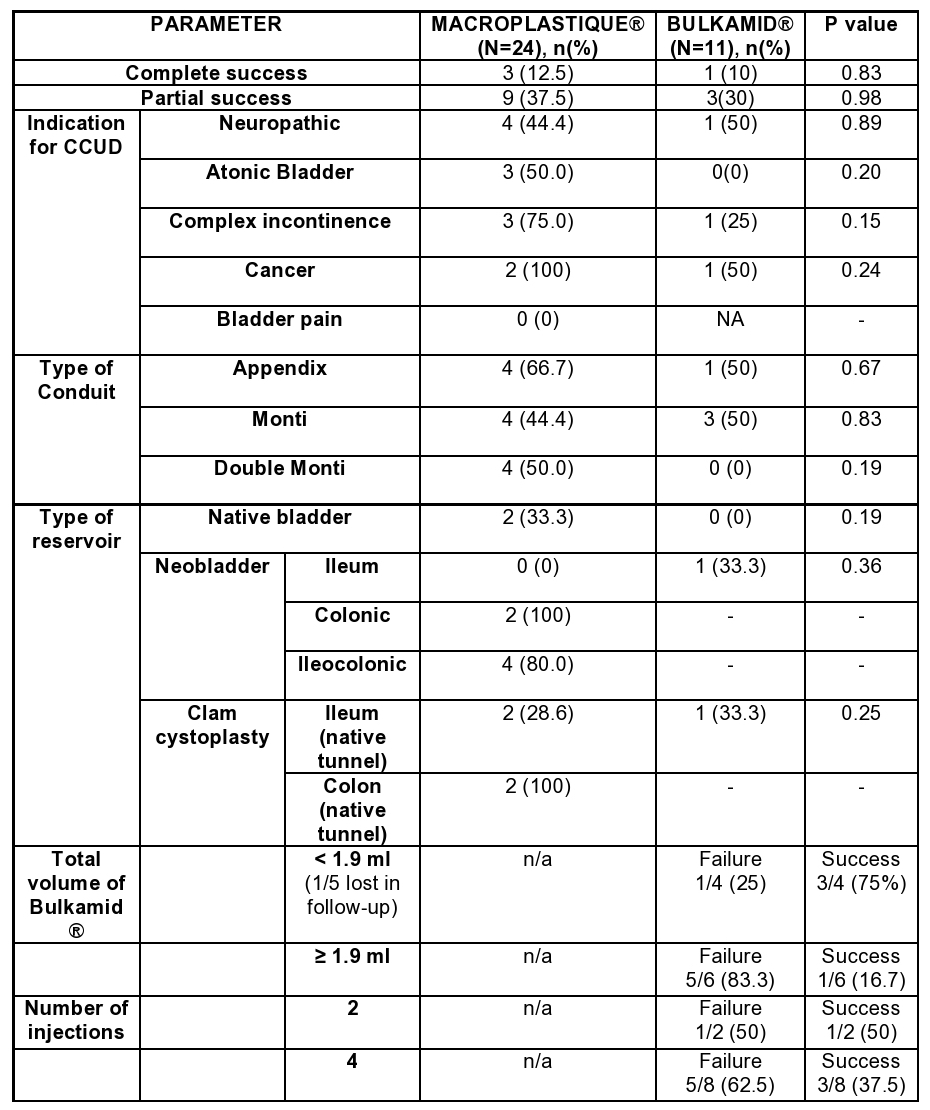
Introduction: We have previously published outcomes of polydimethylsiloxane (Macroplastique®) in patients with leakage from their Mitrofanoff channels. Macroplastique® has now been replaced by Bulkamid® hydrogel. We present the outcomes of Bulkamid® injection in the last 5 years and compare it to the previous usage of silicone. Methods: We retrospectively analysed data 2016-2021 for patients who had previously undergone Mitrofanoff channel formation who received Bulkamid® injections for incontinence. Effectiveness was assessed by the number of pads used before and after injection. Outcomes were classified as complete success (dry), partial success (>50% reduction incontinence pads) and failure. We also calculated success by channel type, type of reservoir and for number and volume of injections per treatment. Results: Results are shown on Table. 11 female patients had Bulkamid® injection to their Mitrofanoff channels due to urinary leakage. Mean age was 45.9 (range 21-67) and median follow-up 16 weeks (range 1-44). 9 patients received Bulkamid® injections once, whilst 2 patients received injections twice. Initial injection was partially successful in 4/10 patients (40%) and a second injection in 1 patient (cumulative success rate 45%), but only 1 patient was completely dry (9%).Of the 5 failures, 2 had revision of their Mitrofanoff channels with success. The 5 successful injections were given to 4 patients with Monti channels and 1 with appendiceal channel (3 patients ileocystoplasty and 1 with ileal neobladder). None of the injections given to native bladders were successful. The mean volume of the injected Bulkamid® gel was 1.9mls (range 0.5-4mls). Greater volumes did not improve success rates, as 3/4 successful injections had a volume less than 1.9 ml. Comparison to Macroplastique® showed no statistical difference in the success rates between the two injectable bulking agents. Conclusions: Bulkamid® injection to Mitrofanoff® channel had a partial response (45%) in the management of incontinence through a Mitrofanoff channel, but was curative in only 9%. Success rates for Bulkamid® seem to be comparable to the ones previously reported for Macroplastique®. Bulking may, at least, defer the necessity for major surgical revision. SOURCE OF Funding: None