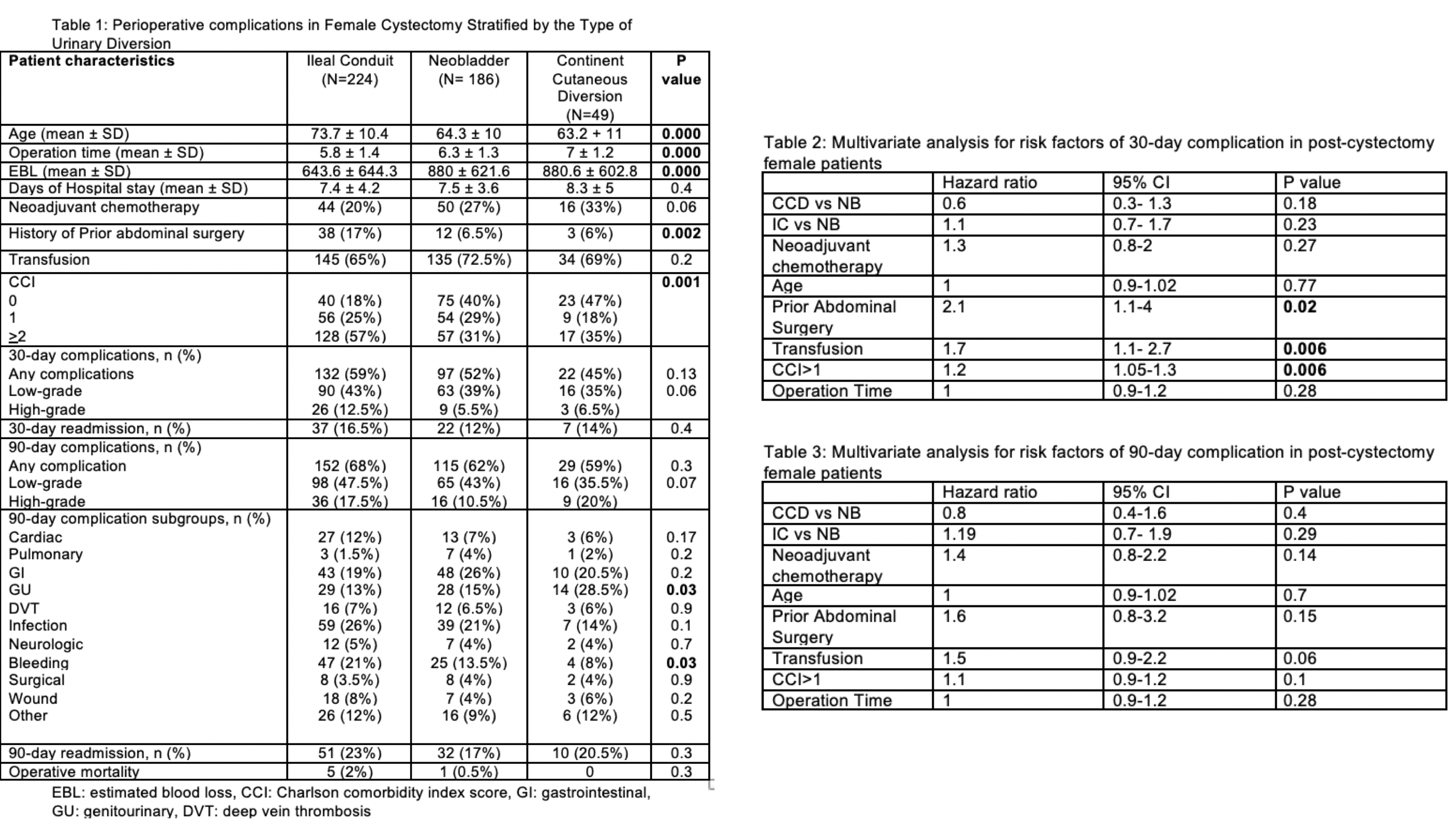
Introduction: It has long been believed that certain diversions may be more likely to cause issues than others in females with bladder cancer undergoing radical cystectomy. In this study, we evaluate the impact of different types of urinary diversions on complication rates following radical cystectomy in females and assess the risk factors for post-cystectomy complications in this population. Methods: Using our IRB approved prospective bladder cancer database, we identified all female patients who underwent radical cystectomy with an intent to cure from 2003 to 2021. Patients were stratified into 3 groups based on their type of urinary diversion including ileal conduit (IC), neobladder (NB) and continence cutaneous diversion (CCD). Baseline characteristics and perioperative complications were compared between the three groups. Univariate and multivariate logistic regression tests were used to assess the risk factors of 30- and 90-days complications. Results: A total of 459 female patients were included of whom 224 (49%) received IC, 186 (40.5%) had NB and 49 (10.5%) CCD creation. Table 1 describes the baseline characteristics and post-operative complications of patients based on their type of urinary diversion. Patients with IC had significantly higher rate of prior abdominal surgery (P=0.002) and higher Charlson comorbidity index (CCI) score (P=0.001). Post-operatively there was no significant difference in the total rate of 30- and 90-days complications in patients with different types of diversions. However, patients with CCD had higher rate of genitourinary complication compared to IC and NB (28.5% versus 13% and 15%, P=0.03). Multivariate analysis showed that prior abdominal surgery (HR 2.1, 95% CI 1.1-2.7, P=0.02), operative bleeding (HR 1.7, 95% CI 1.05-1.3, P=0.006) and CCI>1 (HR 1.2, 95% CI1.05-1.3, P=0.006) are associated with 30-days post-cystectomy complications regardless of the type of diversion (Table 2). We were unable to find any significant risk factor for 90-days complications (Table 3). Conclusions: The results of this study demonstrated that urinary diversion type has little bearing on post-cystectomy complications, while baseline patient characteristics, such as CCI and prior abdominopelvic surgery, have a significant impact on short-term post-operative complications. SOURCE OF Funding: None