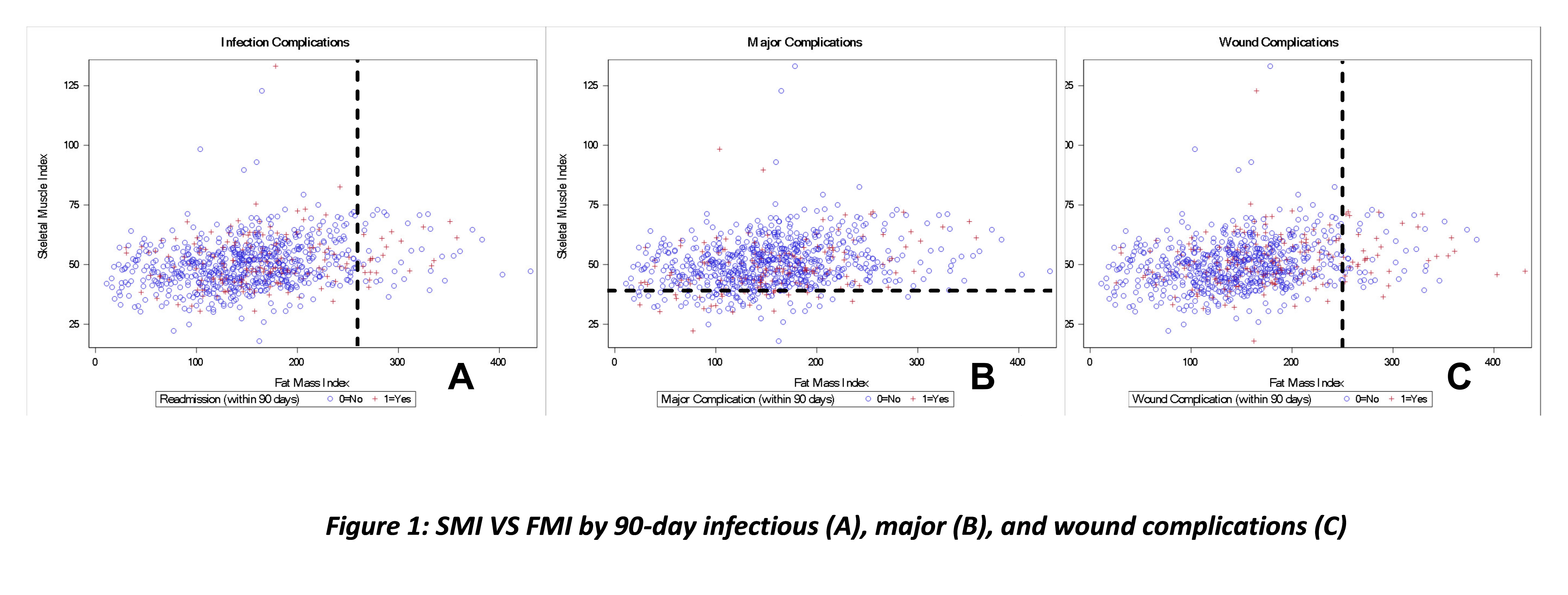
Introduction: Sarcopenia is associated with increased mortality after radical cystectomy (RCx). Traditional imaging techniques used to assess sarcopenia are time consuming and labor intensive. Herein we demonstrate the utility of an AI algorithm with deep learning to analyze CT scans and produce body composition parameters in a time-efficient manner. This allows for outcome prediction and correlation of body measures to post-RCx complications. Methods: Perioperative CT images for 843 RCx patients from 2009-2017 were collected from our institution. An AI algorithm was developed to extract muscle and adipose tissue parameters from 2D axial images at the L3 level. The following areas were segmented: skeletal muscle (SM), visceral adipose tissue (VAT), and subcutaneous adipose tissue (SAT). Skeletal muscle index (SMI) and fat mass index (FMI) were then calculated. All measures were correlated with post-RCx complications using multivariable logistic regression analysis. Results: There was significant variation in pre-operative body composition (Figure 1). An FMI>208 was associated with significantly more wound complications (40% vs 19%, p<.001) while an FMI>260 was associated with more infectious complications (38% vs 21%, p=.003). After adjusting for patient characteristics, these associations of FMI were maintained on multivariable analysis for more infectious (Odds ratio (OR) 1.004, p=.002) and wound (OR 1.006, p<.001) complications. When examining the components of FMI, SAT was independently associated with more wound complications (OR 1.003, p=.006) whereas VAT was independently associated with increased odds of 90-day infectious complications (OR 1.002, p=.011). Similarly, an SMI <42 was associated with major complications (28% vs 17%, p=.002), and on multivariable analysis higher pre-operative SMI was associated with lower odds of major complications (OR 0.972, p=.008). Conclusions: An AI algorithm was successfully able to segment body composition areas of adipose and skeletal muscle tissues. Sarcopenia assessment using this AI technology is now clinically feasible. Changes in body parameters corresponded with changes in body indices and were predictive of wound, infectious, and major complications. SOURCE OF Funding: None.