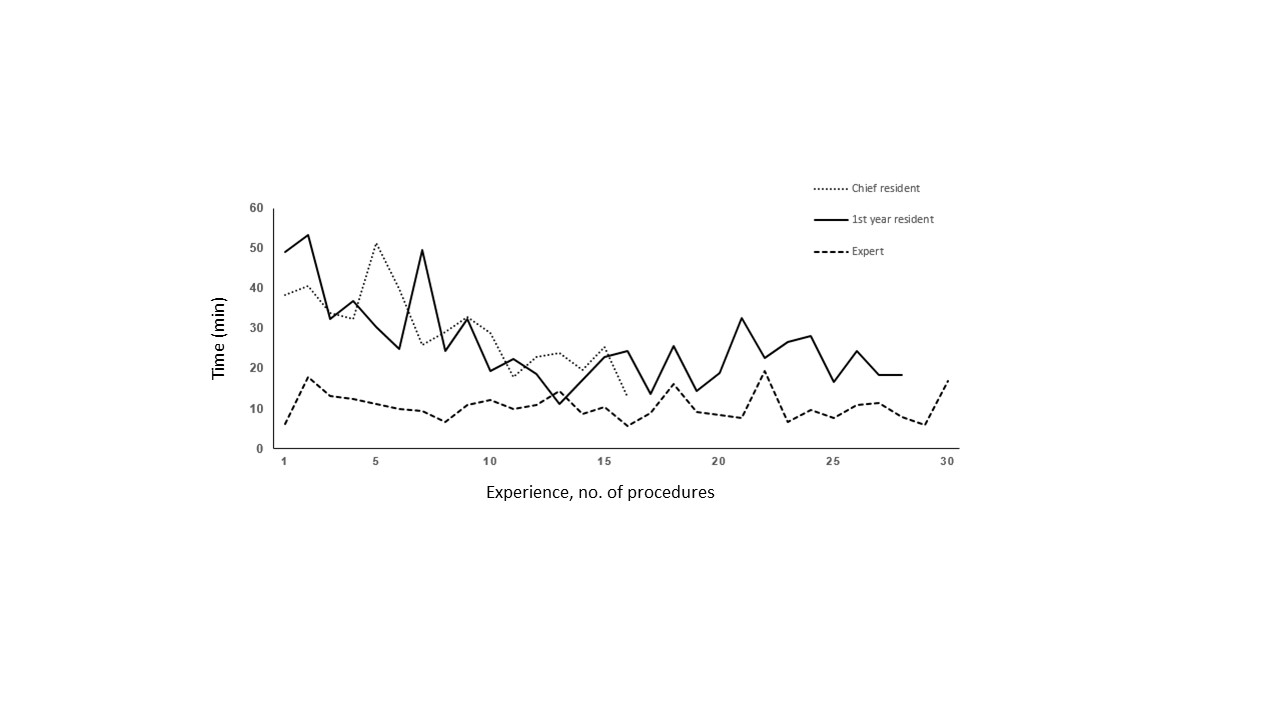
Introduction: Robotic-assisted fusion prostate biopsy platforms promise precision, while offering user-friendliness, short procedure times and low complication rates. To date, there is no study investigating the learning curve (LC) of robotic-assisted transperineal MRI/Ultrasound fusion-guided prostate biopsy (RA-TP-FBx). A LC is essential to facilitate efficient training, maintain institutional biopsy quality and assess potential for widespread use. Herein, we are the first to assess the learning curve of RA-TP-FBx using the iSR’obot MonaLisa device (Biobot). Methods: We prospectively analyzed consecutive RA-TP-FBx performed at the University Hospital Basel from January to October 2022. Cases were randomly assigned to the urology chief resident, a first-year biopsy-naive resident and an expert in RA-TP-FBx senior consultant. All resident cases were supervised by the expert. We used multiple parameters to define the LC: 1) efficiency – measured by time for completion of individual procedure steps, 2) accuracy – defined as detection rate of prostate cancer (PCa) and clinically significant PCa (csPCa) stratified by PI-RADS score, 3) operator and supervisor performance evaluation – measured by entrustable professional activities (EPA) questionnaires, 4) workload assessment – measured by the NASA task load index and 5) complication rates. Results: We collectively performed 75 procedures. Procedure time reduction is shown in Graphic 1. The major difference in procedure time between residents and expert stemmed from probe positioning and biopsy time. PCa was detected in 62% and csPCa in 44%. csPCA detection for PI-RADS 4 was 46%. PCa detection rate for PI-RADS 4 lesions was similar between operators and over time. 13 biopsies were necessary before stable independent completion of all procedure steps. The most difficult skill for residents was ultrasound probe positioning. A transition point for workload reduction was observed at 13 biopsies. Complications rates were similar among operators and over time. Conclusions: Urology residents can quickly acquire skills to independently perform RA-TP-FBx regardless of previous biopsy experience. RA-TP-FBx is a procedure with low workload stress. Safety and accuracy are ensured during the LC when supervised by an expert. SOURCE OF Funding: Department of Surgery, University Hospital Basel