Fellow Ohio State University Wexner Medical Center
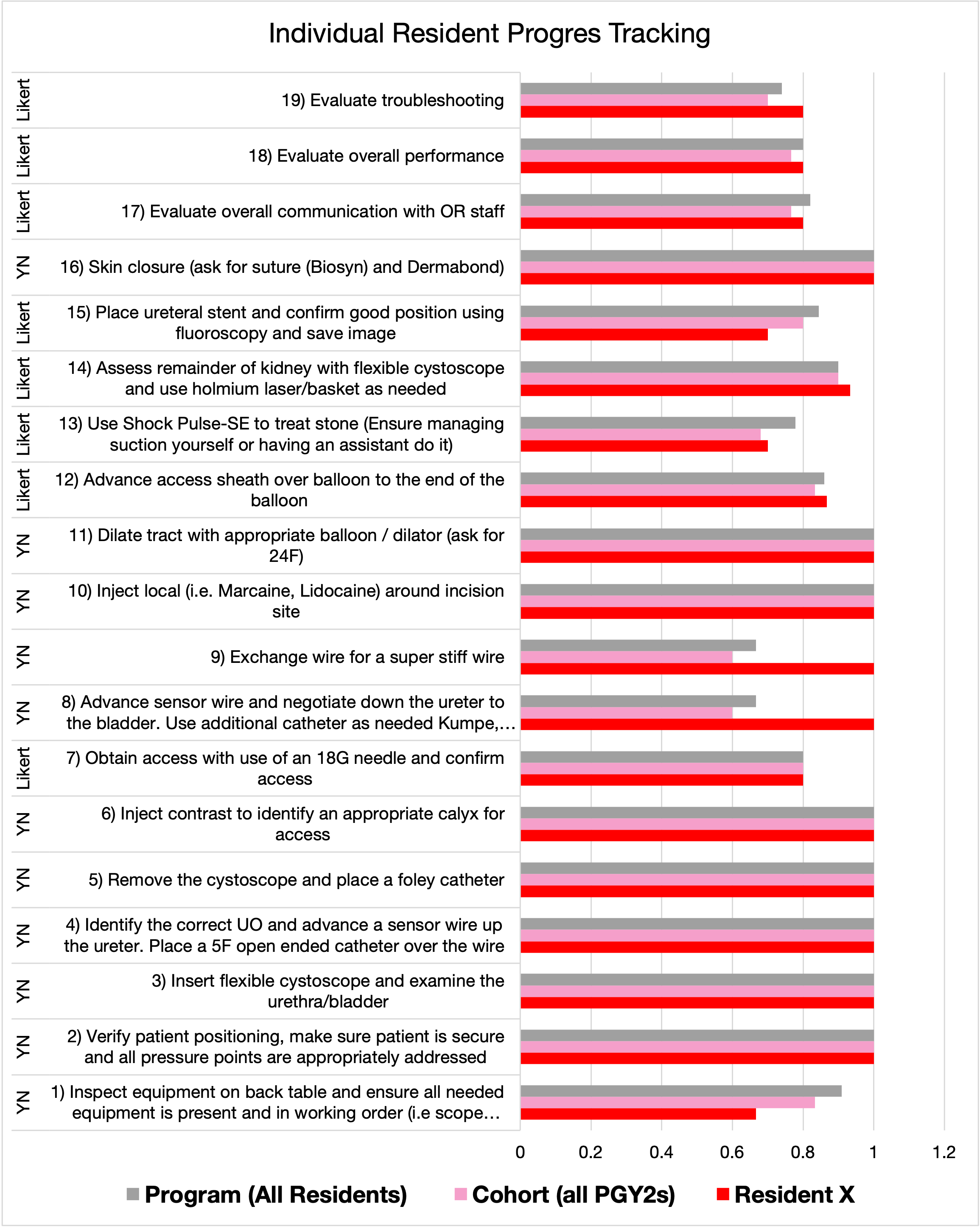
Introduction: With the continuing push towards competency-based training during residency, there have been tools developed for skills assessment. There is currently no standardized assessment for percutaneous nephrolithotomy (PCNL). We evaluate the use of a mobile phone-based application to provide real-time assessment of resident surgical competence and progression during PCNL. Methods: A procedure-based assessment was created to evaluate critical steps during PCNL. To date, 11 residents in our program performing PCNL were immediately evaluated by the faculty involved in the case. Residents were evaluated across 20 steps (see Figure 1), with critical steps of the case being assessed with use of either a Yes/No completion score or via Likert-scale (1–novice to 5–expert). Case complexity was rated on a scale of 1-3 (simple to complex). Results: A total of 19 PCNLs (14 standard, 5 mini) were evaluated involving PGY2-5 for this pilot use of the evaluation tool.As an example, data from a single resident (“X”, n=3 cases to date) was compared to their cohort (PGY2) and program (all residents). Across cohorts, resident exhibited similar competency to their cohort and program, with higher competency for Steps 8/9 (Figure 1). Metrics can be tracked based on level (Figure 2) or by case complexity (Figure 3). Lower competence as an average and over time (case-by-case) would indicate areas where residents can improve or where faculty can provide additional feedback. Average duration to enter feedback was 154 seconds. Conclusions: Given the need and push for real-time feedback in the operating room to assess learner autonomy, this mobile phone-based application is easily created and accessed and allows for prospective and longitudinal tracking of operative skill and progress during PCNL. SOURCE OF Funding: None