Session: MP68: Surgical Technology & Simulation: Instrumentation & Technology II
MP68-08: Watts HAPPENING: Comparing the Thermal Profile of Holmium:YAG Laser (HL) Lithotripsy at Fixed Power (40W) in an Anatomical hydrogel Pelvicalyceal system (PCS) Model
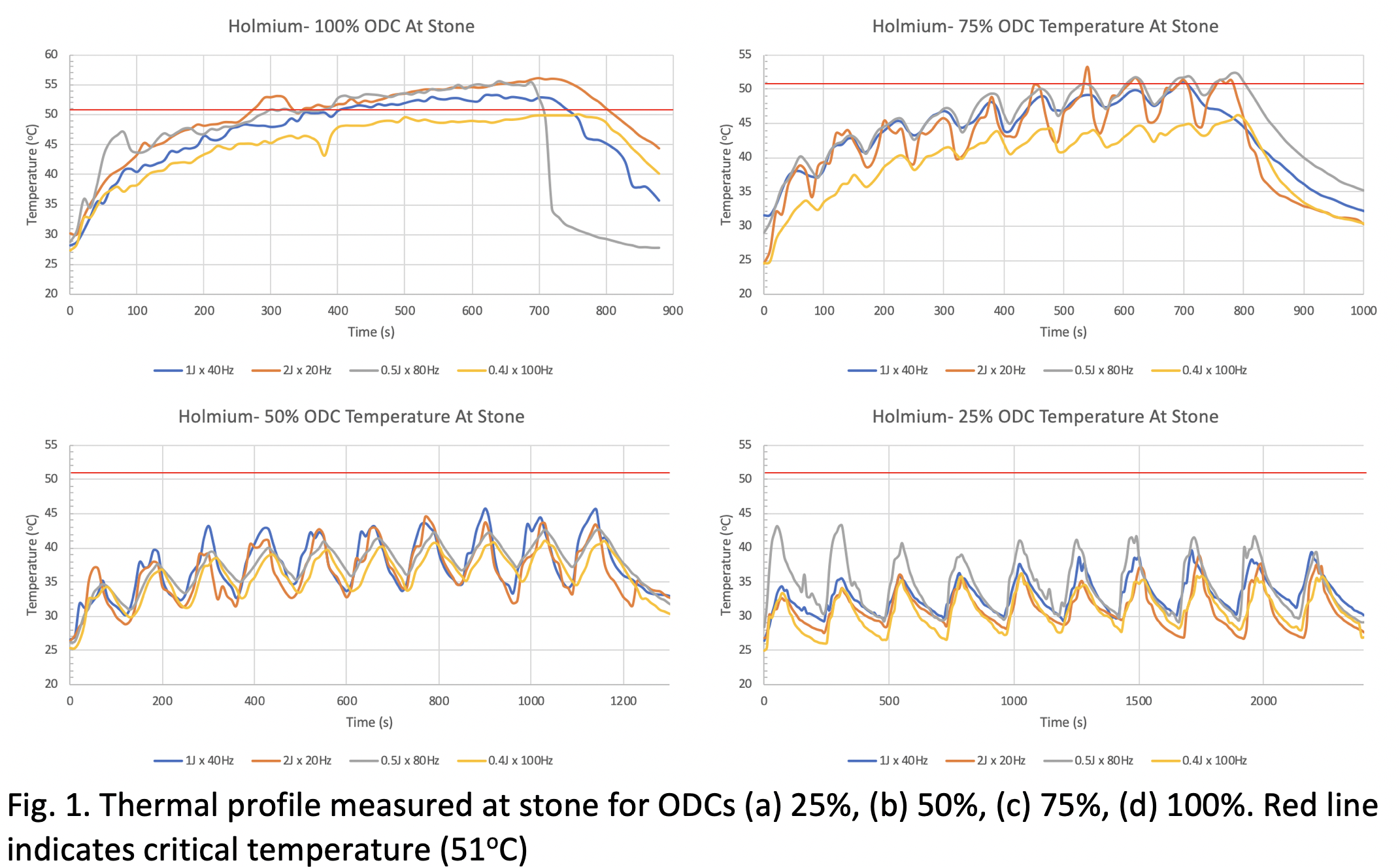
Introduction: Various studies have evaluated temperature profiles during laser lithotripsy. In-vitro settings (e.g., glass tubes) usually lack actual stone ablation, thus poorly correlate to anatomic/clinical practice. In vivo models require significant resources and are not easily reproducible. We sought to evaluate the temperature profile of (1) 4 different laser settings at a standardized power (40W), (2) compare 4 Operator Duty Cycles (ODC) for each setting in a realistic in-vitro setting. Methods: In an anatomical hydrogel model of a human PCS validated with mechanical and computational fluid dynamics testing containing a 2cm pelvic BegoStone, lithotripsy was completed using the Moses 2.0 (200um laser fiber, short pulse) via flexible ureteroscope with standardized irrigation. 2 fragmentation (1J x 40Hz, 2J x 20Hz) and 2 dusting (0.5J x 80Hz, 0.4J x 100Hz) settings were tested in duplicate at ODCs of 100%, 75%, 50%, and 25%. Temperature was recorded in real time using thermocouple probes (Omega, Norwalk, CT). Statistical analysis was completed with a non-linear regression in a third-order polynomial model (Prism 9). Results: 80 experiments were run. At 100% ODC a statistically significant difference in mean overall temperatures (p < 0.0001) was found between each 40W setting. 2J x 20Hz recorded the highest (56.2oC) and 0.4J x 100Hz the lowest (51.5oC) temperatures after 12 minutes. Critical temperature (51oC) was reached at 280s, 390s, 410s and 680s for 2J x 20Hz, 0.5J x 80Hz, 1J x 40Hz, and 0.4J x 100Hz respectively. Differences in mean temperatures between each 40W setting remained statistically significant at 25% (p < 0.0001), 50% (p=0.0009) and 75% (p < 0.0001) ODC with lowest temps generated for 0.4J x 100Hz in all ODCs (Fig 1). Critical temp was not reached for any 0.4J x 100Hz setting or any 50% and 25% ODC iteration. Critical temp was reached for 75% ODCs (xxs on/xxs, off) at 540s, 610s and 700s for 2J x 20Hz,0.5J x 80Hz and 1J x 40Hz. Conclusions: Despite standard 40W power settings temperature profiles differ significantly with variations in energy (J), frequency (Hz), ODC. Finally, the greater the ODC/ longer laser-on time the greater the rise in temperature; indicating that time-off also plays a crucial role in the temperature regulation during laser lithotripsy. SOURCE OF Funding: Internal Funding