Session: MP68: Surgical Technology & Simulation: Instrumentation & Technology II
MP68-09: Validation of an objective pressure test for urethrovesical anastomosis in a non-biohazardous robot assisted radical prostatectomy simulation model
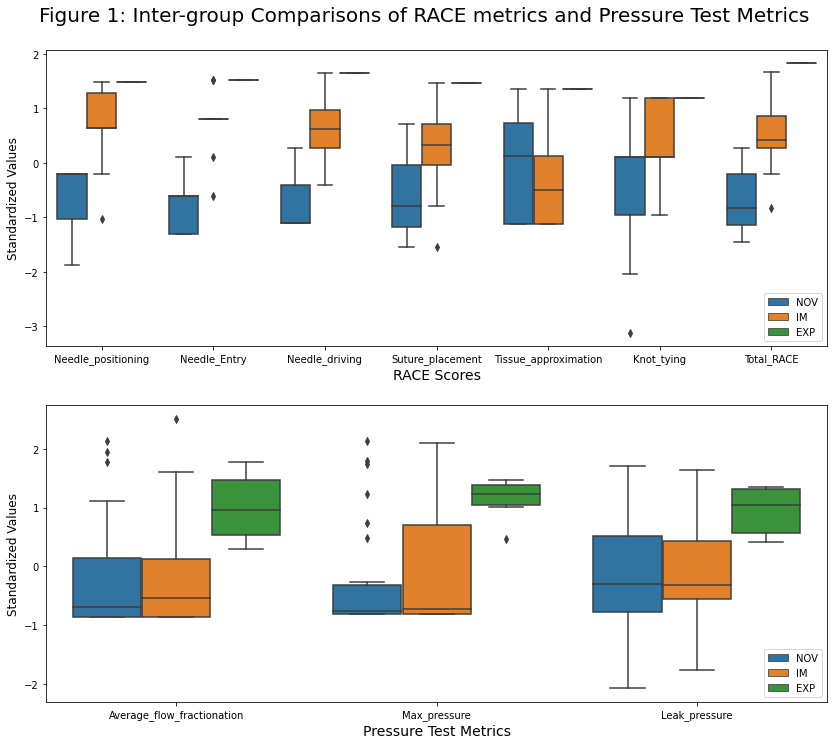
Introduction: Urethrovesical Anastomosis (UVA) is a critical step within Robot Assisted Radical Prostatectomy (RARP) which directly influences postoperative complication and continence recovery. The current standard for assessing UVA proficiency is mainly through the Robotic Anastomosis Competency Evaluation (RACE), a subjective video-based grading system. We have previously validated embedded force sensors within realistic RARP models as an objective method to measure torque during nerve sparing. Herein, we developed an adjacent pressure test with parallels to common urodynamic testing as an objective metric to evaluate UVA integrity in our RARP simulation. Methods: 48 simulated robotic UVA were completed by urologists with varying experience levels: 6 experts (EXP), 16 intermediates (IM) and 26 novices (NOV)). Following simulation, bladders were dissected from surrounding tissue and subjected to a pressure leak test. Bladders were filled to predetermined volumes at a constant rate. Internal volume when leakage at the UVA site started and at end of filling were measured, then used to calculate maximum internal pressure (Pmax) and pressure at leakage start (Pleak). Flow Fractionation (FF) was calculated by allowing free fluid flow through both UVA site and urethra onto separate, tared scales and recorded throughout the test. RACE scores were assigned by two blinded expert video reviewers. Results: EXP showed higher Pmax, FF, and Pleak versus NOV (P=.0009; P=.005; P=.011) as well as EXP vs IM (P=.028; P=.047; P=.047), however IM vs NOV lacked significance. Multivariate analysis found significant positive correlations between Knot Tying (KT), Suture Placement (SP) and Tissue Approximation (TA) with FF (P=.017; P=.051; P=.0007) and Pmax (P=0.01; P=.087; P=.0005). TA and KT had significant correlations with Pleak (P=.0027; P=.085) (Figure 1). Conclusions: The bladder pressure test and its parameters we have developed represent three objective metrics that can be used to assess the ability of a trainee to complete a UVA that would succeed in an intraoperative leak test. Stratification of test difficulty towards the upper end of the RACE score spectrum offers more granularity by which intermediates can assess performance vs experts. SOURCE OF Funding: n/a