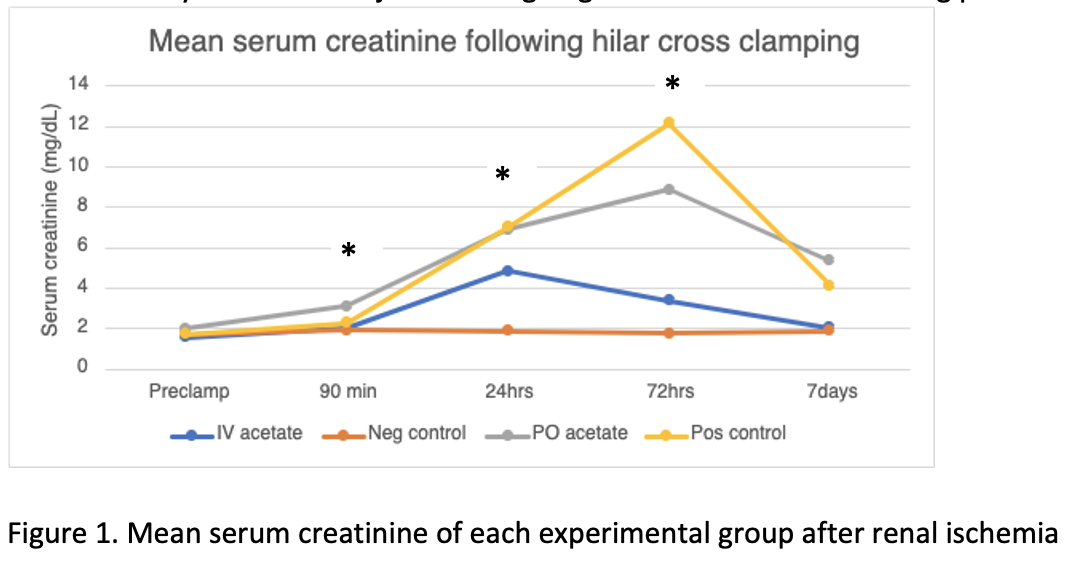
Introduction: The use of medication to avoid ischemia related kidney injury following hilar occlusion has been previously investigated. Renoprotection appears to be conferred by HIF-2A activation which can be stimulated by exogenous acetate administration. The goal of this project was to assess whether administration of acetate in a pig model can negate kidney injury related to ischemia-reperfusion following renal vessel occlusion. Methods: For this study we selected a porcine single-kidney model. First, a laparoscopic radical nephrectomy was performed, and the pigs were recovered. After seven days, the pigs underwent laparoscopic hilar dissection with 90 minutes of cross clamping on the contralateral kidney to simulate renal vessel occlusion during a partial nephrectomy. We employed block randomization of four experimental groups. Pigs in Group 1 received 150 mEq of sodium acetate intravenously during cross clamping. Group 2 received 0.75 g/kg of oral sodium acetate for three days leading up to the day of cross clamping. Group 3 received no acetate and underwent hilar dissection without any cross clamping. Group 4 also received no acetate and underwent hilar dissection with 90-minute cross clamping. Basic metabolic and complete blood panels were drawn after nephrectomy, immediately before and after cross clamping, at 24 and 72 hours and then 7 days after cross clamping. Serum creatinine was used to evaluate renal function. Results: We performed a total of 16 procedures allocating 4 pigs for each experimental group. All pigs were 6-month-old females with median mass of 34.6 kg. One pig from Group 1 had to be excluded due to renal failure. Figure 1 demonstrates the mean serum creatinine for the experimental groups at each time point following hilar cross clamping. A significant difference in serum creatinine was observed at 90 minutes (p=0.038), 24 hours (p < 0.001) and 72 hours (p=0.002) after crossing clamping for the pigs receiving intravenous acetate. The same effect was not observed for the pigs receiving oral acetate. Conclusions: We observed that the administration of intravenous acetate did confer a significant renoprotective benefit in our ischemia-reperfusion porcine single kidney model. This work is hypothesis generating and could lead to performing a similar study in human subjects undergoing renal hilar occlusion during partial nephrectomy. SOURCE OF Funding: Institutional.