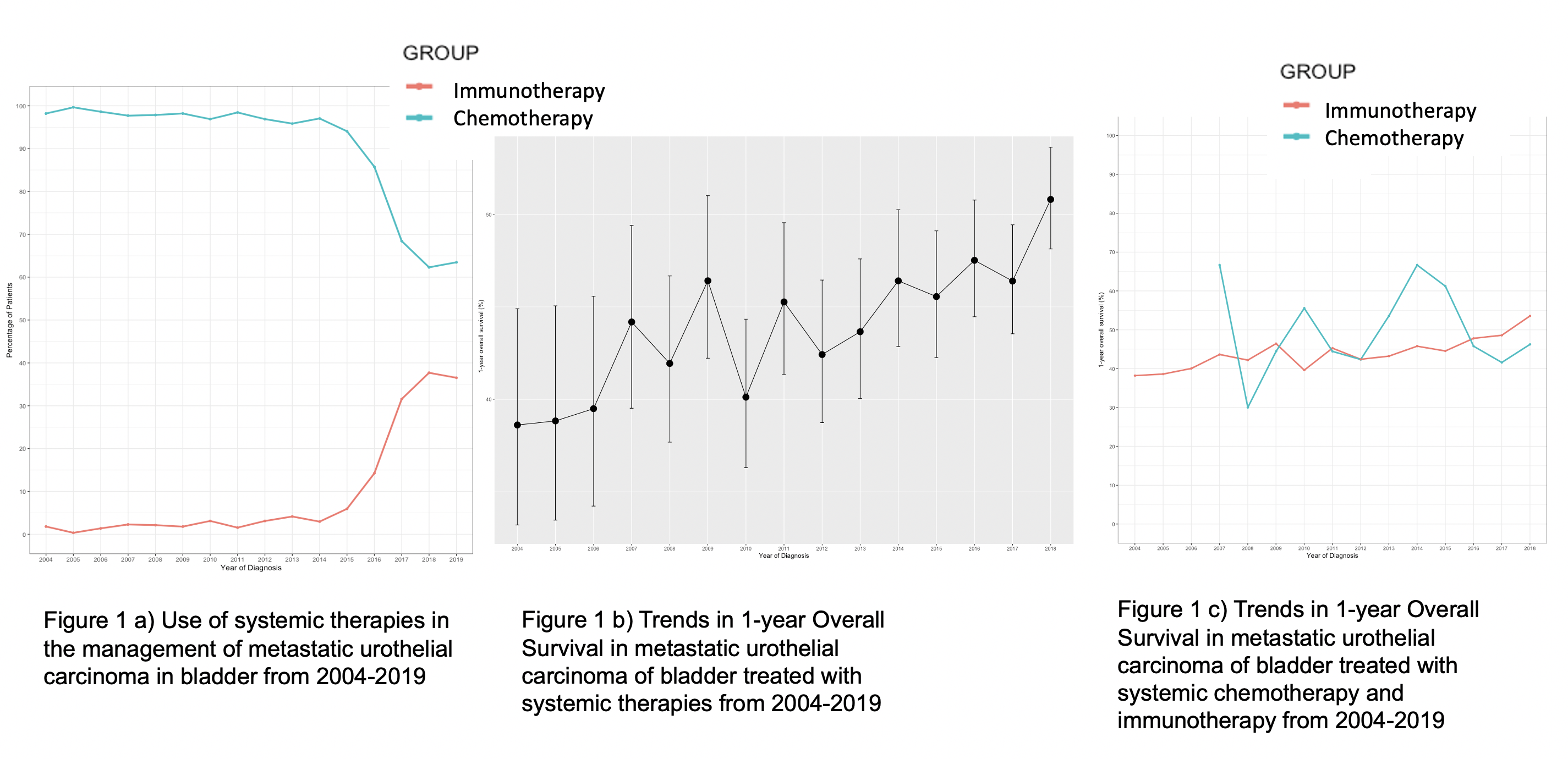
Introduction: The management of metastatic urothelial carcinoma of the urinary bladder has been revolutionized with the advent of immune-checkpoint inhibitors (ICI). However, the survival outcomes in metastatic bladder cancer over the past decade with improvements in systemic therapies have not been studied. The aim of the study is to investigate the time trends in treatment strategies and overall survival (OS) in patients with metastatic urothelial cancer of the bladder. Methods: Using the recently updated National Cancer Database, patients with newly diagnosed metastatic urothelial cancer of the urinary bladder between 2014-2019 were included. We analyzed changes in the first-line systemic treatment and the changes in the 1-year OS using cox multivariable regression and Kaplan Meier analysis. The OS analysis was censored at 1-year to account for possible bias due to shorter follow-up in most recent years. Results: Overall, 10,965 patients met the inclusion criteria with 9,229 receiving systemic chemotherapy and 1,666 patients receiving systemic immunotherapy. The use of immunotherapy increased from 2.3% (9/391) in 2007 to 36.5% (484/1325) to 2019 (p < 0.001) and the use of systemic chemotherapy decreased from 98.2% (270/275) in 2004 to 63.5% (841/1325) in 2019 (p < 0.001). (Figure 1a). The median and 1-year OS of the entire cohort increased from 9.9months and 38.6% in 2004 to 12.5 months and 50.8% in 2018 respectively (p < 0.001) (Figure 1b). From 2009 to 2018, the 1-y OS improved gradually from 38.3% to 53.6%in systemic chemotherapy and 44.4% to 46.3% in the systemic immunotherapy group. (Figure 1c) The improvement in systemic chemotherapy arm could be potentially attributed to increased use of second line immunotherapy in this cohort. Conclusions: The use of immunotherapy as first-line therapy has substantially increased over the past years. The median OS in metastatic bladder cancer has also improved over the past 15 years, possibly because of the advent of immune-checkpoint therapy. SOURCE OF Funding: None