The Ohio State University Wexner Medical Center Department of Urology
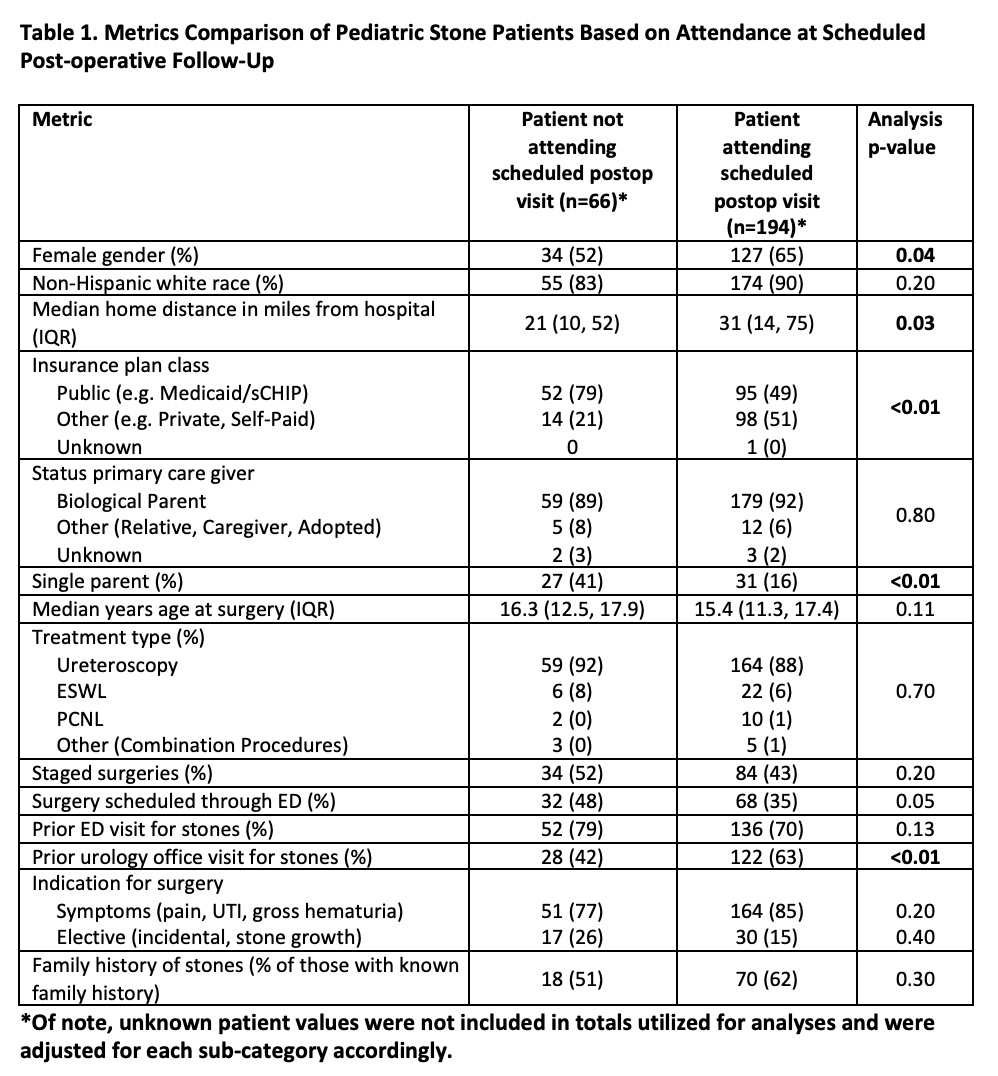
Introduction: While studies in adult kidney stone patients have found social and demographic factors influence medical compliance, there is limited data in the pediatric patient population. We investigated if socioeconomic and demographic factors predict post-surgical follow-up in pediatric stone patients. Methods: All patients having kidney stone surgery at a single academic pediatric hospital over a 5 year period (January 2016 - December 2020) were identified through the use of CPT codes specific to ureteroscopy, shock wave lithotripsy, and percutaneous nephrolithotomy. Electronic charts were reviewed for patient demographics and social factors. For each discrete stone episode (defined as care for a stone within a 6 month window), patient presentation, stone characteristics, and characteristics of intervention were also collected. Appropriate follow-up compliance was reported as having a scheduled and attended provider visit within 6 months after last discrete stone episode surgery. Univariable analyses were performed to test for factors associated with follow-up using Fisher’s exact test for categorical variables and Wilcoxon rank-sum test for continuous variables. Results: 271 pediatric patients, a median age of 16.0 years (IQR 12.0, 18.0) at surgery, were identified. The majority were non-Hispanic white (90%) and female (62%). Most had undergone ureteroscopy (86%). In general, almost all had a postoperative provider visit scheduled after surgery (260; 96%), with 194 (75%) attending that visit. The attached table demonstrates metrics compared between groups that were compliant with follow-up and those that were not (Table 1). Factors associated with lack of follow-up were having public insurance and being from single-parent homes (p < 0.001). Patients with a prior urology clinic visit and those living farther away were more compliant with follow-up (p < 0.05). Conclusions: Kidney stone disease is not benign and surgery is not without risk; follow-up compliance remains of critical importance. We identified public insurance as well as single parenthood to be potential predictors of pediatric follow-up compliance. Identifying factors that may predict non-compliance could be used to help at-risk patient populations. SOURCE OF Funding: None