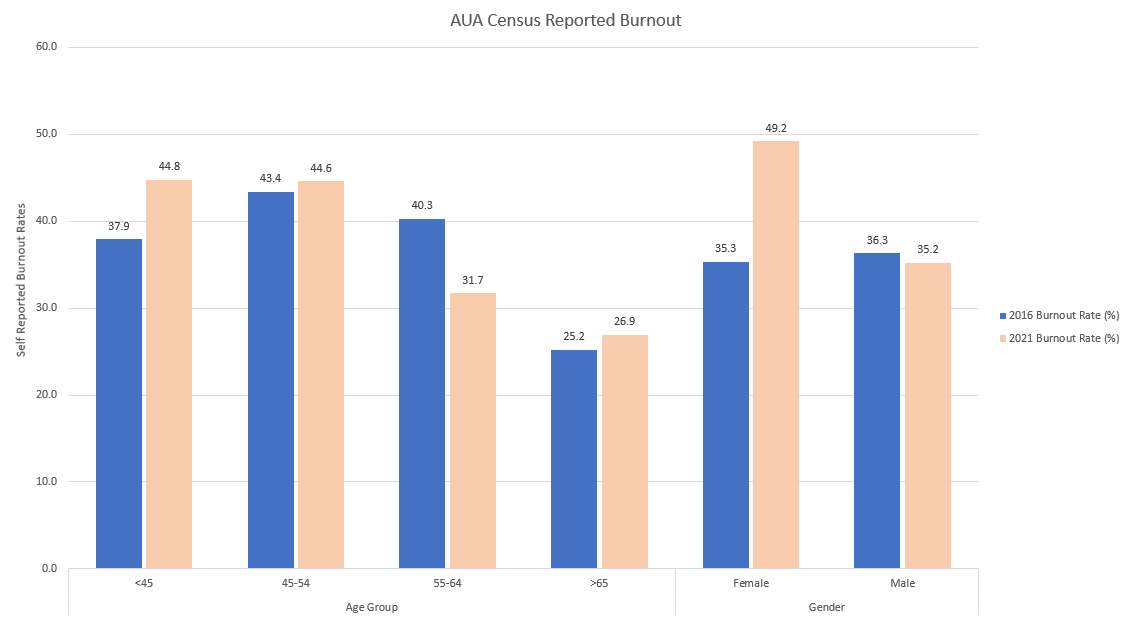
Introduction: Urologists are experiencing burnout at an alarming rate. With this, the American urologic Association (AUA) has continued to collect various pertinent workforce metrics in the annual census. Here the AUA Workforce Workgroup compares the latest data collected in the census related to burnout, comparing these metrics over time. Methods: The AUA Workforce Workgroup examined the annual census results since 2016. The AUA sends out an annual census to all practicing urologists. The census works to collect demographic and geographic data, in addition to collecting answers to other pertinent questions from practicing urologists. Particular to this study, burnout related data was examined from the past 5 years. Examined metrics included burnout assess across age and gender, effect of COVID on burnout, work-personal life conflict across demographic groups. Results: In 2021, 36.7% of urologists report burnout compared to 36.2% in 2016. When assessing by gender, burnout in men decreased from 36.3% to 35.2%, but increased in women from 35.3% to 49.2%. When examined by age, the largest increases in burnout were seen in the <45 years old group, increasing from 37.9% to 44.8%, followed by 45-54 years old, 43.4% to 44.6%. Those over age 55 either had a decrease or stable burnout. When asked about the effect of COVID-19 on burnout, 54% of urologists didn’t feel COVID-19 impacted burnout. When considering work-life conflicts, 25.0% of men and 4.6% of women reported no conflict between work and personal responsibilities, while 25.7% of men and 44.7% of women resolved conflicts in favor of work or were unable to resolve them. Respondents were then asked how satisfied they were with work-life balance, where 22.5% of men, and 37.1% of women responded dissatisfied. Similarly, 33.6% of males reported their work schedule does not leave enough time for personal/family life, compared to 57.5% of females. Conclusions: Overall, urologists have higher burnout now when compared to 2016. The gender discrepancy has vastly widened with women experiencing burnout at an increased rate compared to 2016, while burnout in men decreased. Burnout has increased the most in younger urologists, with the highest increase seen in those <45 years old. Further action is needed to substantiate the causes of burnout. SOURCE OF Funding: None