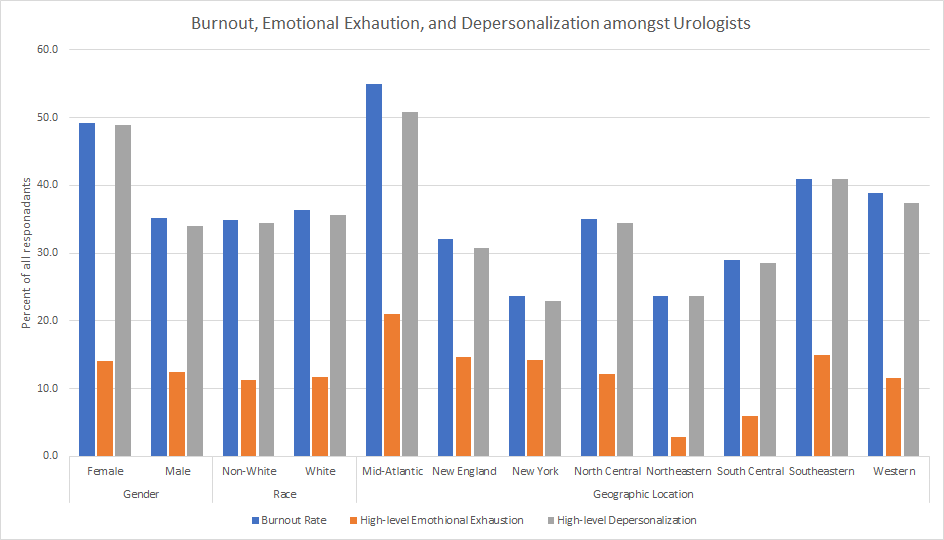
Introduction: Burnout continues to be a substantial issue among urologists. Burnout has been associated with depression, and poor patient outcomes. While this has been examined across our specialty, the AUA workforce workgroup sought to provide more granularity to enhance understanding. Methods: The 2021 AUA census included the Maslach Burnout Inventory to further elucidate burnout among practicing urologists. The AUA data team provided statistical support. Data was collected regarding burnout, components of burnout including emotional exhaustion (EE) and depersonalization (D), and work-life balance questions. These results were then examined by race, gender, and AUA section. Statistical significance was set as p <0.05. Results: Statistically significant differences are reported. Urologists in private practice reported higher burnout rates compared to those in academia, 39% vs 34%. Urologists subspecializing in urologic oncology reported higher burnout when compared to pediatrics and others (46% vs 25% vs 39%). Regarding EE, non-white members were more likely to experience low levels (67 vs 63%) while white members were more likely to experience moderate EE (25% vs 22%). Females were more likely to experience moderate to high-level EE than males. Non-white members were more likely to experience moderate D (26% vs 20%) than white members. The Mid-Atlantic section was more likely than others to report high-level D (51%), with the next closest being the Southeastern section (41%). Female members were more likely to experience high-level D (49% vs 34%). Regarding work-life balance, females were more likely to be dissatisfied (37% vs 23%). Females were more likely to feel their schedule had enough personal/family time (58% vs 34 % for males). No differences in race or geographic region were seen regarding enough personal/family time. Conclusions: Specific demographic differences are seen across burnout variables. Racial, gender, and regional variability should be further examined. Widespread variability, as seen in gender across multiple variables, is of considerable importance. An individualistic approach and local leadership engagement is prudent. The AUA workforce workgroup will continue to aid in understanding these issues among our members. SOURCE OF Funding: None