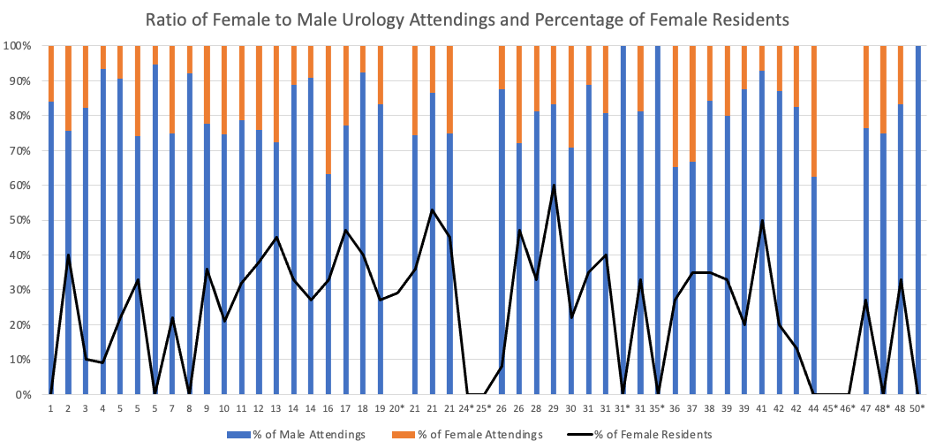
Introduction: Women have been underrepresented in medicine, with that disparity especially evident in Urology. U.S. News World Report (USNWR) evaluates programs based on Medicare data sources and creates ranking based on patient outcomes, patient experience, nursing staff, patient volume and expert opinion. Studies suggest female Urologists are underrepresented in academic institutions, have lower publication numbers, and have slower progression from assistant professor to associate professor than male Urologists. We seek to describe the composition of female versus male attendings in the top 50 Urology departments across the United States using the 2022 USNWR ranking. Methods: Using the 2022 USNWR top 50 institutions in Urology, we collected data using each institution’s website. We collected number of male attendings, number of female attendings, percentage of female residents in the program, presence of FPMRS fellowships and the gender of the chairperson. For institutions missing information on faculty, an asterisk was placed. Female to male urology residency ratio was calculated by female residents divided by total number of residents in the program. Results: Of the top 50 Urology hospitals by 2022 USNWR ranking, 3 females are chair of their department. 26 of these institutions have a Female Pelvic Medicine and Reconstructive Surgery (FPMRS) fellowship program. The top 25 institutions averaged about 32.3% female residents, similar to 31.7% female residents in institutions ranked from 26-50. The percentage of female faculty in the top 25 institutions ranged from 5-37%, with the mean of 18.7%, similar to institutions ranked 26-50 (0-38% female faculty with the average of 17.9%). Of the programs with chairwomen, female residents represented 22-45% (mean 29.7%), compared to mean 32.2% in programs with chairmen (p =0.73). Female faculty representation was similar between programs with chairwomen (range 9-29%, mean 21%) and chairmen (range 0-38%, mean 18%, p =0.61). Conclusions: Despite increasing female Urology residency representation over time, women remain underrepresented in academic positions within Urology, especially among top ranked programs. Interestingly, the presence of a chairwomen did not significantly increase the proportion of female residents and faculty. Future directions include examining publication rates and professorial levels in this group. SOURCE OF Funding: None