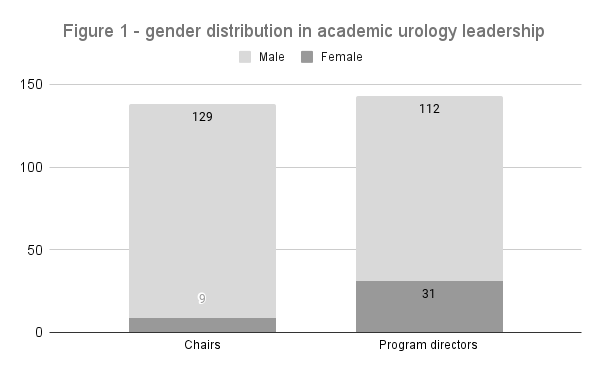
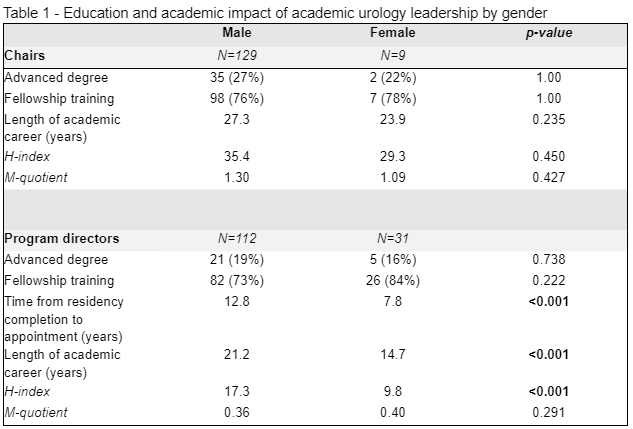
Introduction: Women are increasingly represented among urologic trainees and now comprise 10% of the urologic workforce but are historically underrepresented within academic urology. We aimed to assess the current status of gender equity among leadership positions in academic urology, and to determine whether gender differences exist in objective qualifications. Methods: A cross-sectional study of the 143 ACGME-certified urology residency programs was conducted October 2022. Data regarding department chair and program director (PD), date of appointment, and educational background were collected from publicly available online sources. H-index, a metric of academic impact, was collected from Scopus and the m-quotient (h-index/years since first publication) was calculated to adjust for length of academic career. Statistical analyses were performed with SPSS®. Results: Women comprised 6% of chairs (9/138) and 22% of PDs (31/143). There was no significant difference in length of career, academic productivity, presence of fellowship training or advanced degrees, or geographical location between male and female chairs. Among PDs, there was no significant difference in geographical location, status of fellowship training or advanced degrees. There were significant differences in h-index between male and female PDs (17.3 vs 9.81; P<0.001; 95% CI 4.6-10.4). However, this difference did not remain significant when adjusted for length of academic career (m-quotient). Conclusions: The number of female urologists in academic leadership positions is increasing, particularly among PDs. However, women remain underrepresented at the highest levels of leadership, comprising only 6% of urology chairs. Although female PDs have significantly lower h-indices than male counterparts, there is no significant difference when adjusted for length of career. As mentorship and representation are critical to improving diversity and inclusion within our field, gender equity must remain a priority for academic urologists. SOURCE OF Funding: N/A