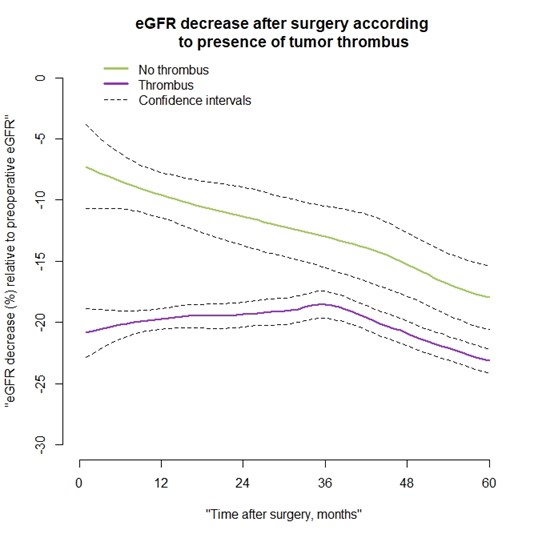
Introduction: Up to 15% of patients with locally advanced renal cell carcinoma (RCC) harbour tumor thrombus (TT). We aimed at evaluating the impact of TT on short and long-term renal function after surgery in a contemporary cohort of RCC patients. Methods: Within a prospective maintained database, 1,307 patients undergoing radical nephrectomy for non-metastatic RCC between 2000 and 2021 at a single tertiary centre were identified. Renal function was calculated based on estimated glomerular filtration rate (eGFR). Acute kidney injury (AKI) was defined according to the RIFLE criteria and chronic kidney disease (CKD) as eGFR <60 mL/min for >3 months after surgery, according to the K-DIGO G-categories definition. Multivariable logistic regression analyses (MVA) assessed the impact of TT on the risk of postoperative AKI, after accounting for age, preoperative eGFR, blood loss and tumor characteristics. Multivariable Poisson regression analyses estimated the risk of eGFR decrease after surgery and a local polynomial smoother weighted function was used to graphically explore eGFR over time according to presence of TT. Results: Overall, 173 (13%) patients showed TT at preoperative imaging. Median age at surgery was 63 [Interquartile range (IQR): 54-72] years. Patients with tumor thrombus showed lower BMI (22 vs. 26 kg/m2), preoperative Hb (11 vs. 13 g/mL) and eGFR (67 vs. 80 mL/min) relative to the overall RCC population. Clinical tumor size was higher in patients with TT (9.2 vs. 6.5 cm). After adjusting for several confounders, presence of TT predicted higher risk of postoperative AKI (OR 1.57, 95%CI 1.33-1.73; p<0.001). Median functional follow-up was 49 (18-85) months. CKD upstage was shown in 57 vs. 38% (p < 0.001) of patients with vs. without TT, respectively. At MVA, presence of TT resulted an independent predictor of greater eGFR decrease at last follow-up (p < 0.001 – Figure 1). Conclusions: Presence of TT in patients undergoing kidney surgery for RCC represents a risk factor for worse long term renal function: these patients experience higher rate of postoperative AKI, as well as of CKD upstage during follow-up. Moreover, while in absence of TT a progressive eGFR decline has been observed over time, patients with TT experience an important eGFR decrease postoperatively, up to 20% of preoperative eGFR, which remains virtually stable over time. SOURCE OF Funding: None