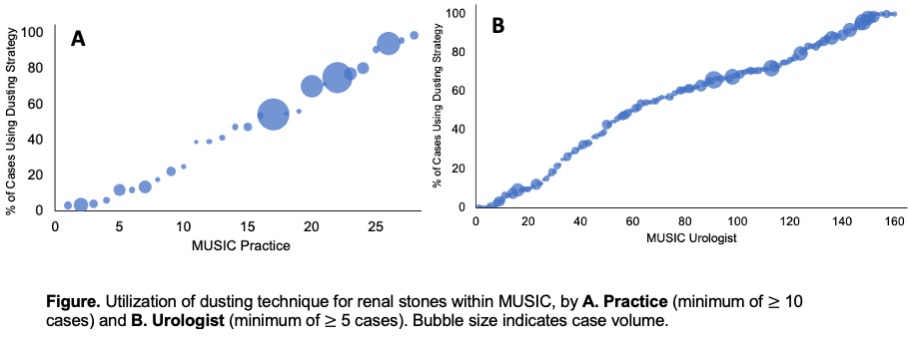
Introduction: Dusting technique for ureteroscopy (URS) laser lithotripsy has become popular, but there remains a knowledge gap about how often it is performed compared to fragmentation with basketing. Prior studies of dusting vs. fragmentation/basketing are from expert single centers and may not reflect real-world practice. We assessed practice patterns and outcomes of the two techniques in Michigan. Methods: Using the Michigan Urological Surgery Improvement Collaborative (MUSIC) registry, we identified all single-stage cases of URS laser lithotripsy performed for renal stones between 2016-2022. Data was collected by independent abstractors at each practice using standardized definitions. Stone-free rate (SFR) was defined as zero fragments on imaging reports (ultrasound, x-ray, CT scan) within 60 days. We assessed practice and urologist-level utilization of dusting vs. fragmentation/basketing. We compared characteristics of patients. Using multivariable regression we assessed the association of each technique with 30-day postoperative emergency department (ED) visits accounting for patient, stone, and surgical characteristics. Results: Among 4,772 ureteroscopy procedures for renal stones performed by 230 surgeons across 34 practices, 2,838 (59%) were performed with a dusting technique. Significant variation in use of dusting was observed across practices (3-99%, p<0.001) and urologists (0-100%, p<0.001) (Figure). Utilization was greatest in larger practices. Dusting was used more frequently for larger stones (median [IQR]: 9mm [7-13] vs 8mm [6-11], p<0.001) and stones in multiple locations (30% vs. 20%, p<0.001). Ureteral access sheaths (55% vs 72%, p<0.001) and post-operative stents (79% vs 86%, p<0.001) were used less frequently with dusting. Post-operative imaging was performed in 48% of patients; SFR was lower with dusting (41% vs 57%, p<0.001). Dusting was associated with higher ED visits on multivariable analysis (OR 1.4, 95% CI 1.1-1.8, p=0.006). Conclusions: Six of ten patients with renal stones undergoing URS are treated with a dusting technique in Michigan. Our data suggests dusting is more frequently used in larger practices which could be related to access of high-power lasers. Real-world practice indicates dusting is associated with more post-operative ED visits. SOURCE OF Funding: Blue Cross Blue Shield of Michigan