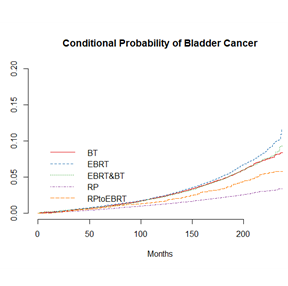
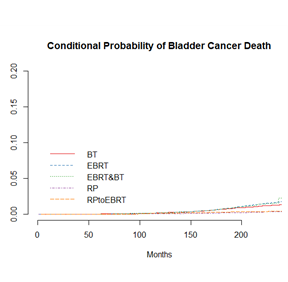
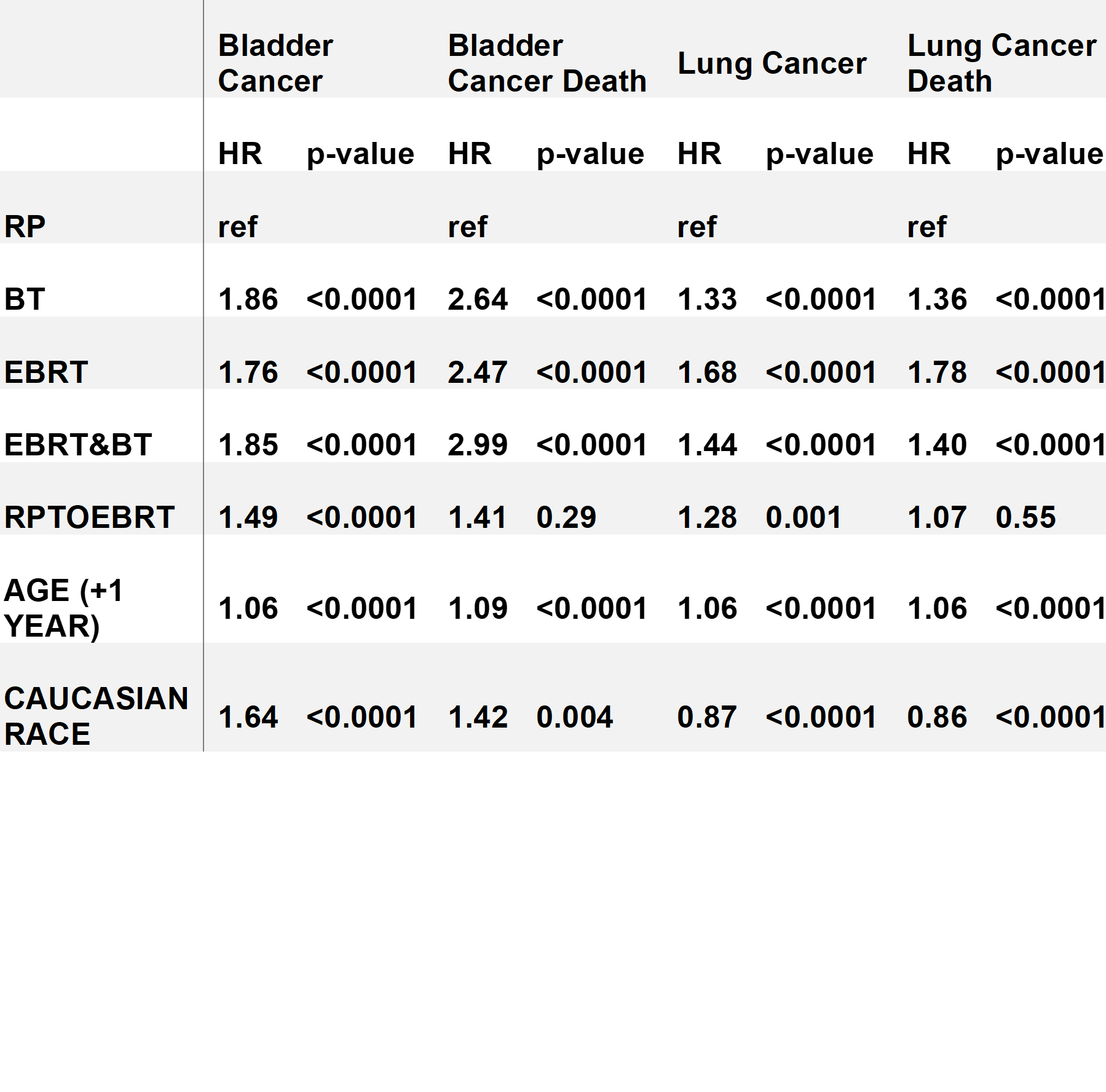
Introduction: The comparative risk of bladder cancer among patients treated for prostate cancer with prostatectomy (RP), external beam radiation therapy (EBRT), and brachytherapy (BT) in long-term follow up is not well known. We aimed to characterize this risk with an age-matched time-to-event comparison between radiation and surgical treatments arms. Methods: Using the 2000 to 2019 SEER database, we identified 261,609 age-matched patients treated for prostate cancer with RP, BT, EBRT, EBRT&BT, and RP followed by EBRT (RPtoEBRT). Our primary analyses were cause-specific Cox proportional hazards models using time to bladder cancer diagnosis and bladder cancer death as the events of interest. A parallel analysis was run on lung cancer as a control cancer outside of the field of pelvic radiation but also highly associated with smoking status. Results: The adjusted cause-specific hazard ratio of bladder cancer diagnosis after prostate cancer treatment, compared to RP as reference, was 1.86 for BT, 1.76 for EBRT, 1.85 for EBRT&BT, and 1.49 for RPtoEBRT (p < 0.001). See Table 1. Except for in RPtoEBRT, the hazard ratios for bladder cancer death among the radiation arms were even greater, 2.64 for BT, 2.76 for EBRT, and 2.99 for EBRT&BT. Lung cancer was associated with all radiation arms (p < 0.001) but at lower hazard ratios. Conclusions: Radiation, in all forms, is associated with bladder cancer diagnosis and death, when matching and controlling for age. Although a major limitation is that smoking status is not available within SEER, our lung cancer analysis was intended to address this. The hazard ratios of radiation were much higher for bladder cancer diagnosis and death, compared to lung cancer diagnosis and death. SOURCE OF Funding: None