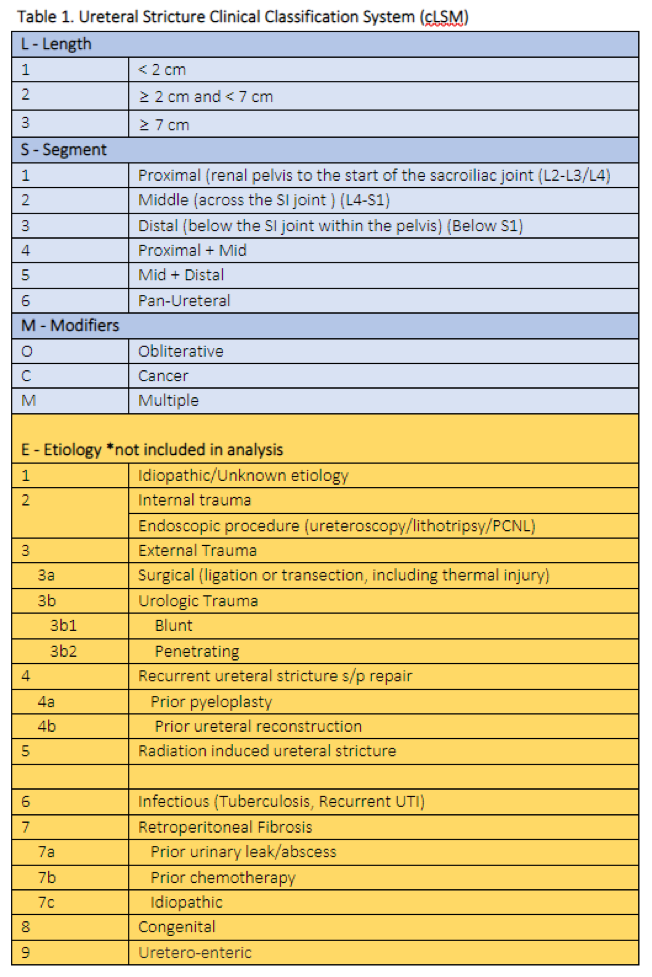
Introduction: The surgical management of ureteral stricture disease is contingent upon multiple factors such as stricture length, location, and etiology. Ureteral strictures are conventionally characterized descriptively. Unlike urethral stricture disease, there is currently no widely adopted classification system. Herein, we aim to propose a ureteral stricture classification system for the purpose of creating a standard nomenclature with the goal of validating classification with reconstructive surgical techniques. Methods: Consensus was obtained from 14 reconstructive urologists. All reviewers had completed a Society of Genitourinary Reconstructive Surgeons (GURS) fellowship and were in clinical practice. Consensus was formulated regarding three primary elements: length of ureteral stricture (L); stricture segment (S); and modifiers (M). These constituted the cLSM classification system (table 1). Each reviewer was presented with an image(s) of fluoroscopic studies for 24 various ureteral strictures with no additional clinical history and were tasked with assigning a cLSM grade for each individual clinical vignette. These results were tabulated and interrater reliability was determined by a Fleiss Kappa analysis. Etiology of stricture was included in the final version of the cLSM classification system but was not designed to be included in this analysis (table 1). Results: Of the 24 ureteral strictures, 11 (45.8%) were proximal, 10 (41.7%) were distal, 2 (8.3%) were mid-ureter and 1 (4.2%) was of overlapping sites. Distal ureteral injuries were assessed with only an antegrade pyelogram hindering a precise length measurement. There was substantial agreement across experts demonstrated by an overall Fleiss Kappa score of 0.677 (0.667 – 0.686) for the 24 clinical vignettes for ureteral length, segment and modifiers. Conclusions: The cLSM ureteral classification system shows a strong interrater reliability by experienced reconstructive urologists. Consistent nomenclature and application of the classification system will standardize discussion of types of ureteral injuries as well as allow for assessment of outcomes. The final ureteral classification system will include etiology (cLSE) to further characterize ureteral injuries and compare reconstructive operative techniques. SOURCE OF Funding: None