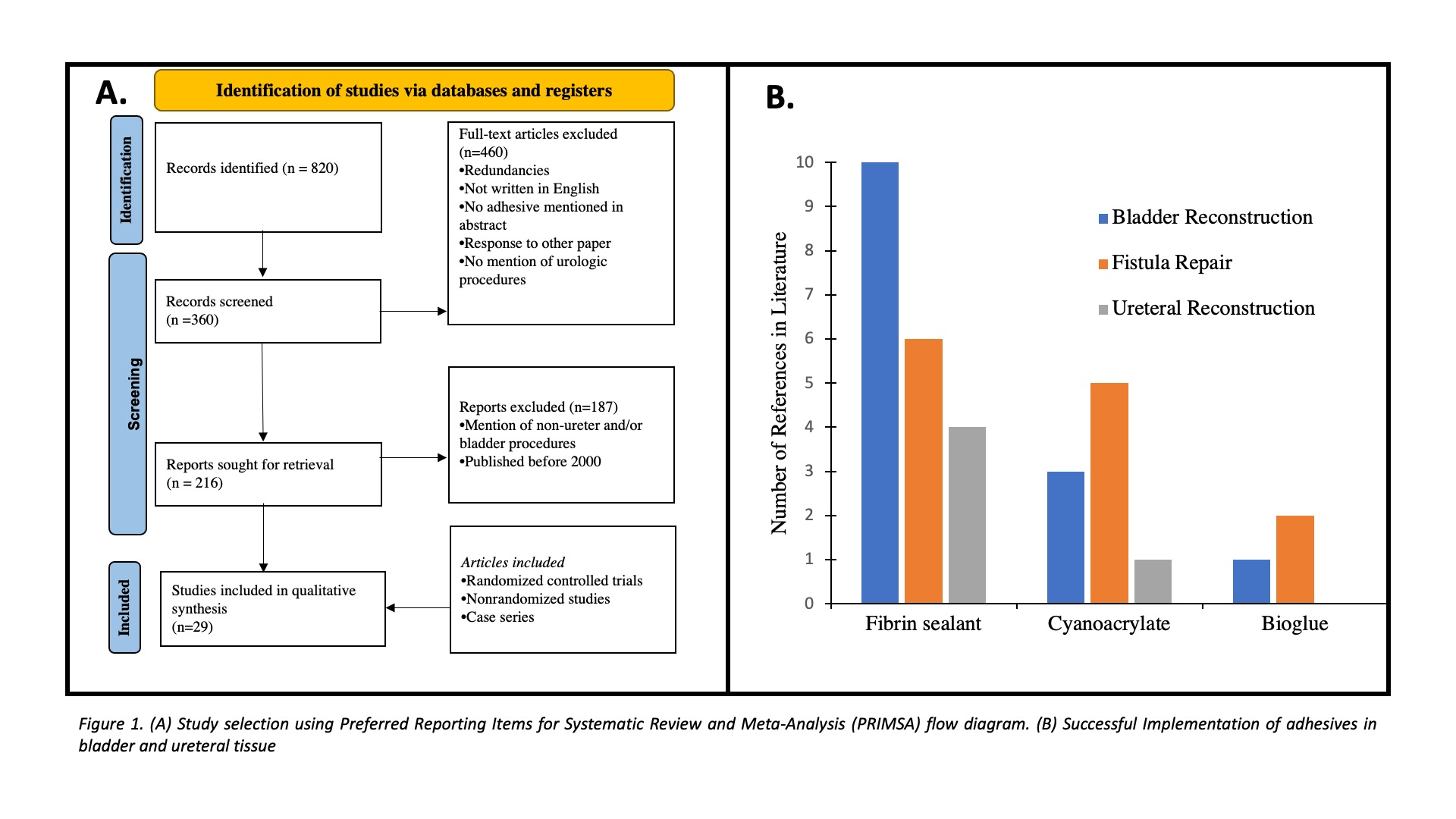
Introduction: While surgical adhesives may be FDA approved as adjunct hemostatic agents or sealants, application is typically off-label for urinary tract tissue. Current literature lacks consensus regarding the role of tissue adhesives for bladder and ureteral reconstruction. This systematic review synthesizes clinical and animal data across key adhesives that have been applied to bladder and ureteral tissue, assessing trade-offs between competing parameters affecting agent selection and effectiveness. Methods: A literature search was conducted in Pubmed, Web of Science, Embase, and Cochrane databases to identify articles published from 2000-2021 that reported urologic reconstruction and the use of adhesive, hemostatic agents, and/or sealants. Figure 1A illustrates identification and inclusion/exclusion criteria. Results: 29 publications were included (18 human, 11 animal; Figure 1B). Fibrin sealant was the most commonly evaluated adhesive, followed by cyanoacrylate and bovine serum/albumin/glutaraldehyde (bioglue). Clinically, all three adhesive types effectively managed fistulas, with significant decrease in operative time, decrease blood loss, and resolution of urinary leakage. When comparing acute inflammatory and wound healing responses, cyanoacrylate demonstrated higher cytotoxicity in comparison to fibrin sealant. No significant inflammation at 1 week (in comparison to sutured closures) occurred following bioglue application. In prior characterization studies, cyanoacrylate had the strongest tensile strength and adhesive parameters; however, no study assessed mechanical or adhesive parameters of fibrin sealants or bioglues in bladder or ureteral tissue. Conclusions: This systemic review provides overall low-level evidence for the application of the three major adhesive types to bladder and ureteral reconstruction as a suture reinforcement. However, these three adhesive types are not equivalent, demonstrating trade-offs between adhesive strength and cytotoxicity. Future research is needed to assess comparative parameters of all three major adhesives, including mechanical and adhesive benchtop testing, effects on wound healing, and long-term outcomes of clinical application to bladder and ureteral tissue. SOURCE OF Funding: National Science Foundation and UCLA Tech Development Group