Session: PD19: Infections/Inflammation/Cystic Disease of the Genitourinary Tract: Kidney & Bladder II
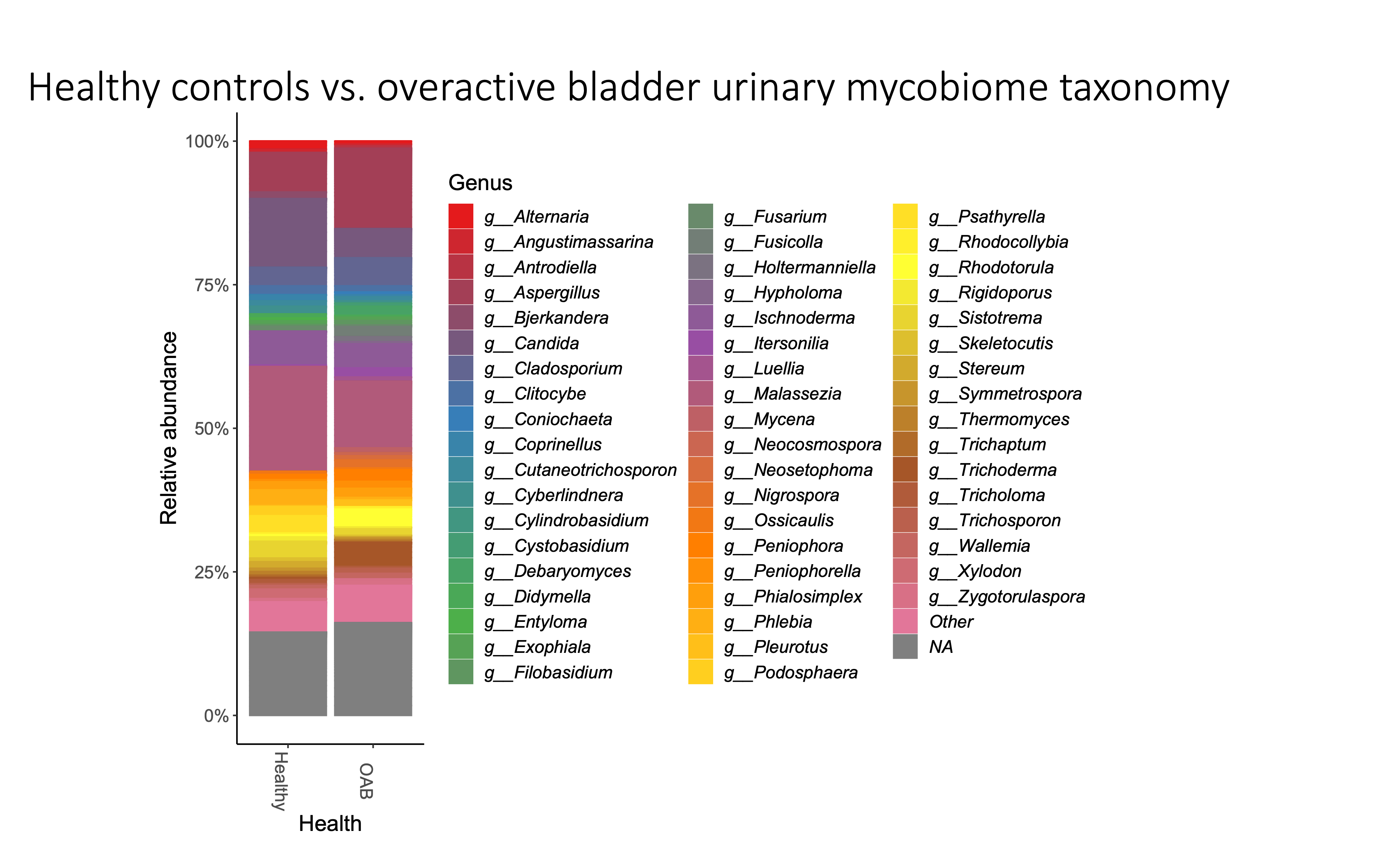
PD19-08: The urinary fungal microbiome in those with overactive bladder is less abundant in Malassezia and more abundant in Aspergillus relative to healthy controls
Introduction: The urinary tract harbors its own microbiota, but fungi composition remains poorly characterized. Overactive bladder (OAB) is a common urologic diagnosis, with predominant symptoms being urinary urgency and frequency. We sought to investigate the urinary fungal microbiome of the overactive bladder population and compare that with healthy controls. We hypothesized that the population with OAB would harbor unique patterns of fungi relative to healthy controls. Understanding the fungi associated with OAB could open new avenues toward the investigation of fungi in disease manifestation and treatment response. Methods: Female patients age 18 and over with overactive bladder by AUA/SUFU criteria were included, as were a group of control adult female patients without urologic diagnoses. Participants provided a clean catch urine specimen. Samples were subjected to next-generation sequencing using ITS primers to capture fungii, and fungal diversity was determined. Diversity and taxonomic profiles were compared between groups by two-tailed t-tests and PERMANOVA. Results: 46 patients with OAB and 32 healthy controls were included. The OAB group median age was 65.7 (IQR 14.3), and the healthy control group median age was 60.4 (IQR 38.6) and. Fungi were detected in all urine samples. The predominant phylum was Ascomycota in overactive bladder patients and Basidiomycota in healthy controls. Malassezia taxa was less (12% OAB, 18% other, p<0.05) abundant in the overactive bladder group and Aspergillus was more abundant in the OAB group (14% OAB versus 7% healthy, p<0.05). Conclusions: The urinary fungal microbiome, or “mycobiome” differed significantly between the selected population with OAB and a healthy control population. Ascomycota was the predominant phylum. Malassezia was less abundant in those with OAB and Aspergillus more abundant. Additional study is needed to further delineate the relationship between the fungal microbiome and OAB, whether it may be a cause or effect of the OAB symptom complex, and whether it can be modulated to improve OAB treatment. SOURCE OF Funding: N/A