Session: MP44: Prostate Cancer: Detection & Screening II
MP44-03: PI-RADS 5 Lesions within the Transition Zone are associated with decreased detection of Clinically Significant Prostate Cancer versus Peripheral Zone lesions in patients undergoing MRI Fusion Prostate Biopsy
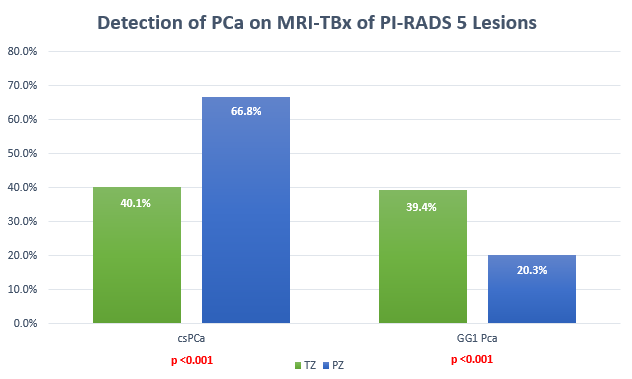
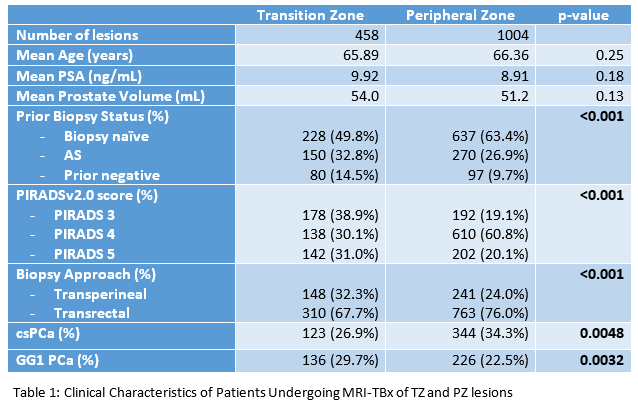
Introduction: MRI-fusion targeted prostate biopsy (MRI-TBx) of Prostate Imaging Reporting and Data System (PI-RADS) lesions in both the peripheral zone (PZ) and transition zone (TZ) has become an integral part of prostate cancer (PCa) diagnosis. However, interpretation of the TZ remains challenging due to a markedly heterogeneous background and benign processes mimicking PCa. Our objective was to examine whether TZ, compared to PZ location, impacted odds of detecting clinically significant PCa (csPCa), defined as International Society of Urological Pathology (ISUP) grade group =2. Methods: We performed a retrospective review of all patients who underwent MRI-TBx at a tertiary care center. Lesion level review was performed to compare MRI-TBx in lesions located in the TZ vs. PZ. The primary outcome of interest was detection of csPCa, however, detection of ISUP grade group 1 PCa (GG1 PCa) was also examined. Multivariable (MV) logistic regression analyses were performed to assess for predictors of csPCa detection. Results: 1464 lesions from 1087 patients were included in the analysis. 31.3% of lesions were located in the TZ. Overall, TZ lesions were significantly less likely to harbor csPCa as compared with those in the PZ (26.9% vs 34.3%, p =0.017). When stratified by PI-RADS score, only PI-RADS 5 lesions demonstrated a significant difference in detection of csPCa between TZ and PZ lesions (40.1% vs. 66.8%, p <0.001). Additionally, PI-RADS 5 lesions in the TZ were significantly more likely to harbor GG1 PCa (39.4% vs. 20.3%, p <0.001). On MV analysis, TZ location remained an independent predictor of csPCa within PI-RADS 5 lesions (OR = 0.35, p <0.001). Conclusions: PI-RADS 5 lesions in the TZ have 65% lower odds of harboring csPCa and are more likely to harbor GG1 PCa than those in the PZ. This has important implications for both risk stratification and consideration of further workup in patients with negative or low-grade pathology on MRI-TBx of PI-RADS 5 lesions. SOURCE OF Funding: None