Session: MP44: Prostate Cancer: Detection & Screening II
MP44-04: Importance of the ultrasound characteristics of regions of interest by MRI and the additional target biopsy around their peri-hypoechoic lesions in MR/TRUS software fusion biopsy to improve detection rate of prostate cancer
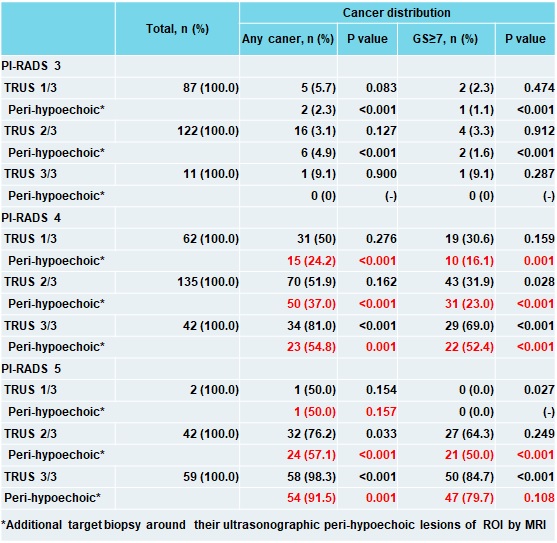
Introduction: We investigated prospectively whether the presence of an ultrasound hypoechoic region at the site of a region of interest (ROI) by magnetic resonance imaging (MRI) and additional target biopsy around their peri-hypoechoic lesions can predict and improve prostate cancer detection in MRI/Transrectal Ultrasonography (TRUS) software fusion prostate biopsy. Methods: From August 2019 to May 2022, a total of 376 patients who underwent multiparametric (mp)MRI and who underwent MRI/TRUS software fusion prostate biopsy by single surgeon were analyzed prospectively. ROI by MRI was prospectively evaluated for presence of a hypoechoic region at the site and graded as TRUS 1/3, 2/3 or 3/3, representing none, a poorly demarcated ROI, or a well demarcated ROI, respectively. The additional target biopsy around the peri-hypoechoic lesions was done. The interaction of PI-RADS version 2.1 and TRUS grade, and the prediction of cancer detection rate by TRUS grade, were evaluated through multivariate analysis. Results: The cancer detection rates for TRUS 1, 2 and 3 were 25.5%, 39.0% and 83.0% (P < 0.001) for any cancer, and 14.0%, 24.6% and 71.4% (P < 0.001) for GS =7 cancer, respectively. For PI-RADS 4, the GS =7 cancer detection rates for TRUS 1, 2 and 3 were 30.6% (P = 0.159), 31.9% (P = 0.028), and 69.0% (P < 0.001), respectively. For PI-RADS 5, the GS =7 cancer detection rates for TRUS 1, 2 and 3 were 0.0% (P = 0.027), 64.3% (P = 0.249) and 84.7% (P < 0.001). The detection rate of GS>7 for peri-hypoechoic lesions with PI-RADS 4 and TRUS 3 was 52.4% (P < 0.001), and the detection rate of GS>7 for peri-hypoechoic lesions with PI-RADS 5 and TRUS 3 was 79.7% (P = 0.108). Multivariable regression analysis and ROC curve showed that high TRUS grade, PI-RADS, and peri-hypoechoic lesion around ROI were predictive of clinically significant prostate cancer. Conclusions: Ultrasonographic findings and additional target biopsy around the peri-hypoechoic lesions at the site of ROI by MRI on MRI/TRUS software fusion prostate biopsy helps independently predict the detection of prostate cancer with PI-RADS score. SOURCE OF Funding: None