Session: MP44: Prostate Cancer: Detection & Screening II
MP44-13: Genetic Risk Assessment of Lethal Prostate Cancer Using Benign Prostatic Hyperplasia or prostate volume-related Polygenic Risk Score and Hereditary Cancer Susceptibility genes
Assistant Professor Johns Hopkins University Bloomberg School of Public Health
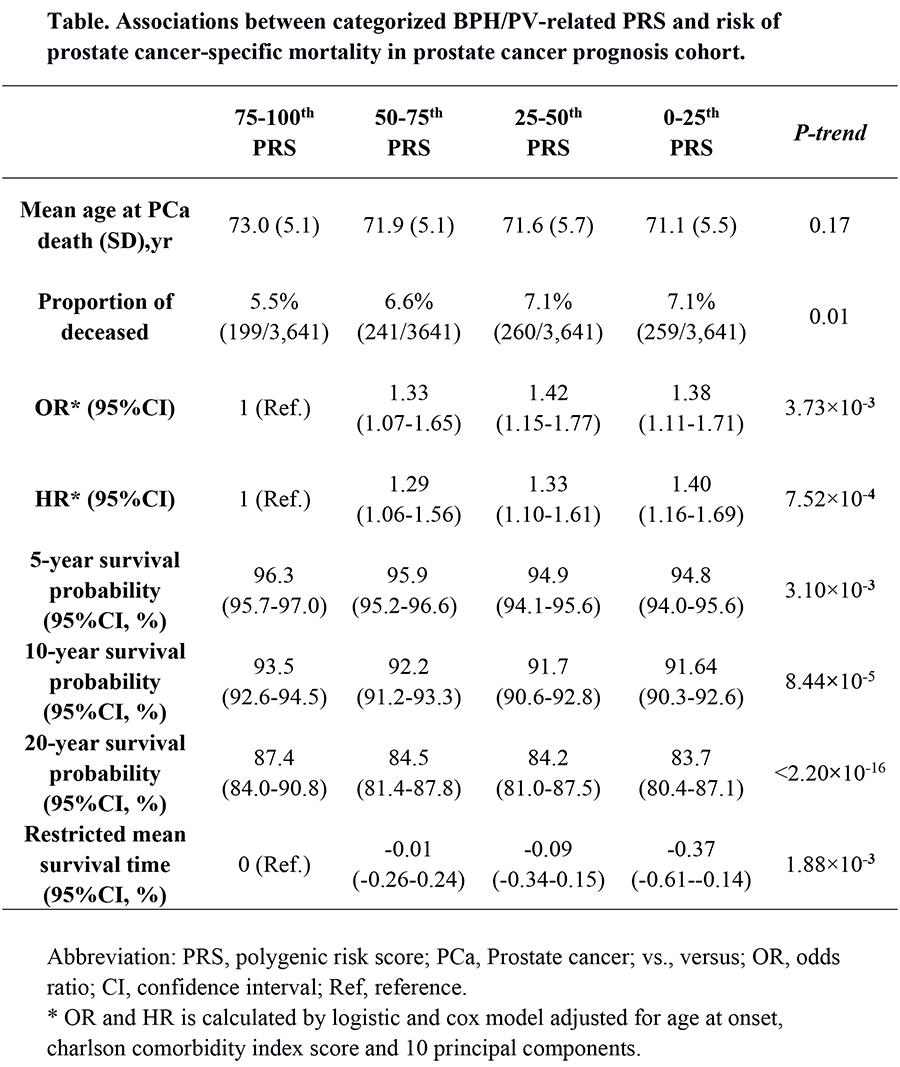
Introduction: Genetic risk of aggressive prostate cancer (PCa) is hard to be assessed due to the lack of aggressiveness-related single-nucleotide polymorphisms (SNPs). Prostate volume (PV) is a potential well-established risk factor for aggressive PCa, we hypothesize that polygenic risk score (PRS) based on benign prostate hyperplasia (BPH) or PV-related SNPs may also predict the risk of aggressive PCa or PCa death. Methods: A PRS using 27 BPH/PV-associated SNPs, two established PCa risk-related PRS (PRATICAL PRS and PHS) and 10 guideline-recommended hereditary cancer susceptibility genes were evaluated and compared in the population-based UK Biobank cohort. Multivariable logistic regression and Cox regression analyses were applied to evaluate the association with the primary outcome (PCa death), adjusting for age at onset, charlson comorbidity index score and 10 principal components. Survival time after PCa diagnosis and the differences across PRS categories were estimated with restricted mean survival time (RMST). Results: The study included a total of 14,564 males were diagnosed with PCa, of which 959 (8.2%) died of PCa, 1,173 (8.1%) died due to other reasons and 12,193 (83.7%) survived till the latest follow-up in Jan 1st, 2022. The BPH/PV PRS was significantly inversely associated with the incidence of lethal PCa as well as the natural progress in PCa patients (hazard ratio, HR=0.92, 95% confidence interval, 95%CI: 0.85–0.99, P=0.03; HR=0.92, 95%CI: 0.86-0.99, P=0.02, Table). Compared with men at top 25th PRS, PCa patients with bottom 25th PRS would have a 1.40-fold (HR, 95%CI: 1.16-1.69, P=0.001) increased PCa fatal risk and shorter survival time at 0.37 yr (RMST, 95%CI: 0.14-0.61, P=0.002). On the contrary, PRACTICAL PRS and PHS showed poor prognostic value (p>0.05). Importantly, BPH/PV PRS could further distinguish the risk of PCa death in addition to the pathogenic mutations in known genes (ie. BRCA2/PALB2), especially in non-carriers. Conclusions: BPH/PV PRS and germline pathogenic mutation in BRCA2/PALB2 were significantly associated with PCa death and cancer-specific survival. SOURCE OF Funding: This work was in supported by grants from National Natural Science Foundation of China (Grant No. 81972645), Innovative research team of high-level local universities in Shanghai, Shanghai Youth Talent Support Program, intramural grant of The University of Hong Kong to Dr. Rong Na, and Shanghai Sailing Program (22YF1440500) to Dr. Da Huang. All the funders had no role in study design, data collection, data analysis, interpretation, and writing of the report.