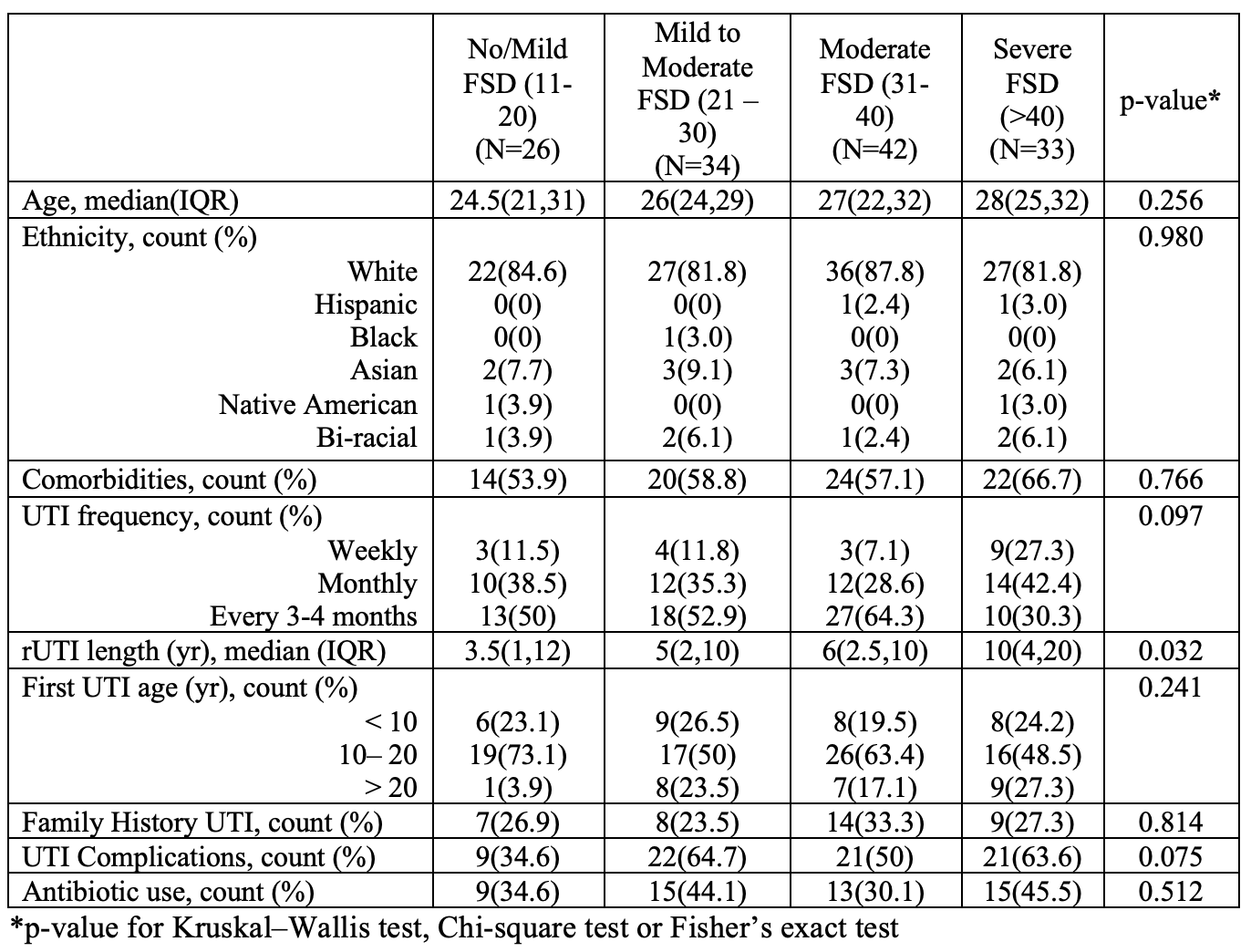
Introduction: In young women, the risk factor most commonly associated with recurrent UTIs (rUTIs) is sexual intercourse. However, few studies have subsequently analyzed the effect of rUTIs on women’s sexual health. Thus, we investigated whether young women with rUTIs experience sexual dysfunction. Methods: Between May – Sept 2022, a survey was posted on 5 subreddits (r/Healthyhooha, r/Interstitialcystitis, r/CUTI, r/WomensHealth and r/badwomensanatomy) with questions pertaining to demographics, rUTI history and the Female Sexual Distress Scale-Revised (FSDS-r). Women answered statements in terms of rUTI frequency and severity, with a scale from 0 (never) to 4 (always). A score =11 indicated female sexual dysfunction (FSD), categorized as mild (11 – 20), mild-moderate (21 – 30), moderate (31 – 40) and severe (=41). Women between 18 – 35 years, not currently pregnant, and who had UTIs at least every 3-4 months were included. Statistical analysis was performed by Kruskal–Wallis, Chi-square or Fisher’s exact tests. Results: One hundred sixty-six women completed the survey and 135 (81.3%) met inclusion criteria. Average age±SD was 26.8±5 years, a majority self-identified as white (84.2%), and over half had a comorbidity (59.3%). Approximately 50% of women experienced UTIs every 3-4 months, 36% every month, and 14% every week. Women had rUTIs for an average±SD of 8.6±8.2 years. Over half (60%) experienced a UTI-related complication requiring hospitalization. In the FSDS-r portion, frustration about sexual problems received the highest average score (2.86/4) and low sexual desire had the lowest score (1.84/4). More than a third of women responded that they frequently avoid sex due to sexual distress (40.7%) and are frequently worried about sex (43.7%). We found that 124 (91.9%) participants qualified as having FSD, with an average score of 31.3±12.5. In terms of FSD severity, 12.1% had mild, 27.4% mild-moderate, 33.9% moderate and 26.6% severe. We found a significant difference between the number of UTI years and FSD severity (p = 0.032). Conclusions: In our study, over 90% of young women with rUTIs qualified as having FSD measured by FSDS-r. Our findings highlight the importance of screening women who experience rUTIs for sexual dysfunction, and providing them with tools to prevent future UTIs, hopefully avoiding long-term consequences and improving overall sexual health. SOURCE OF Funding: N/A