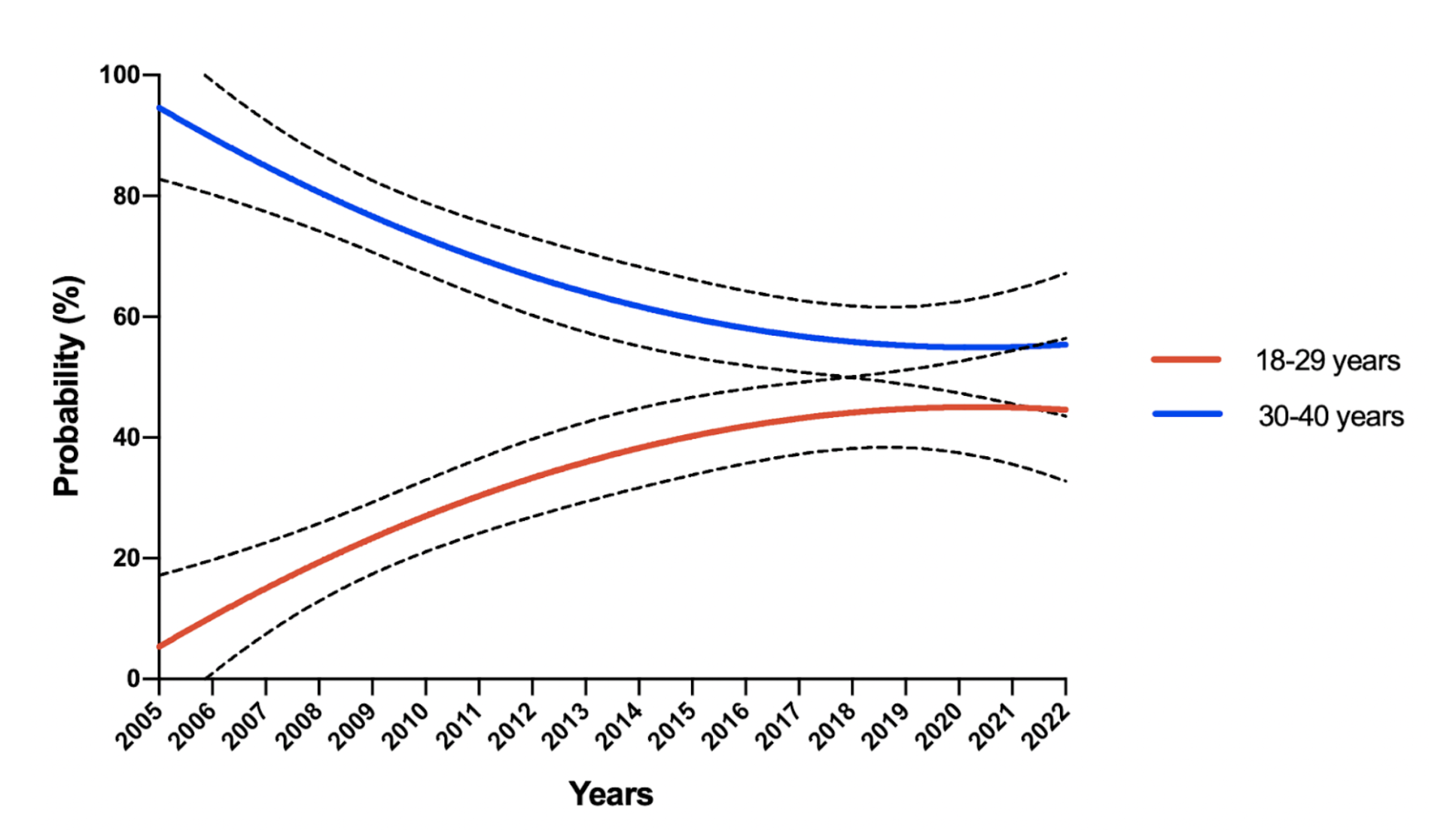
Introduction: Erectile dysfunction (ED) is a relatively common complaint among young men. Prevalence and risk factors of very young men (defined as men younger than 29 yr of age at first presentation) with ED has been scantly analysed. We aimed to assess and compare the sociodemographic and clinical characteristics of young (30-40 yr) and very young (18-29 yr) ED patients and to explore the changes in patterns of reported ED in men with = 29 yr over a 17-yr period at a single academic centre Methods: Data from 519 consecutive patients < 40 yr of age at first presentation for ED as their primary compliant between 2005 and 2022 were analysed. Health significant comorbidities were scored with the Charlson Comorbidity Index (CCI). All patients completed the IIEF. Patients were segregated into two groups: 18-29 vs. 30-40 yr. Descriptive statistics tested sociodemographic and clinical differences between the two cohorts. Linear regression and local polynomial models were applied to explore and graphically display the trend of assessing 18-29 vs. 30-40-yr ED patients over the analysed time frame Results: Overall, 191 (36.8%) were < 29 yr and 328 (63.2%) were 30-40 yr. The two groups did not differ in terms of commonly recognised ED risk factors (CCI, regular physical exercise and regular alcohol use). Rates of severe ED (IIEF-EF <11) did not differ between the two cohorts at presentation (20.9% vs. 18.6%) respectively. Conversely, younger patients were less likely to report a stable partner (45.5% vs. 61.6%, p<0.001), to suffer of arterial hypertension (3.7% vs. 8.5%, p=0.04) and had lower BMI (22.8 vs. 24.5 kg/m2, p<0.001) but higher total testosterone (5.6 vs. 5.1 ng/mL, p=0.01), respectively. At linear regression analysis, patients assessed throughout the 17-yr time frame were progressively younger (Coeff –0.09, p<0.001). Figure 1 graphically displays the probability of assessing younger patients over the 17-yr time frame with median (IQR) age in 2005 of 34 (32-34) yr vs. 29 (25-32) yr in 2022 Conclusions: Among young men seeking first medical help for new onset ED, one out of three has less than 29 yr. Of those, one out of five reports criteria suggestive of severe ED. The probability of assessing very young men complaining of ED (18-29 yr) has worrisomely increased over the last two decades SOURCE OF Funding: .