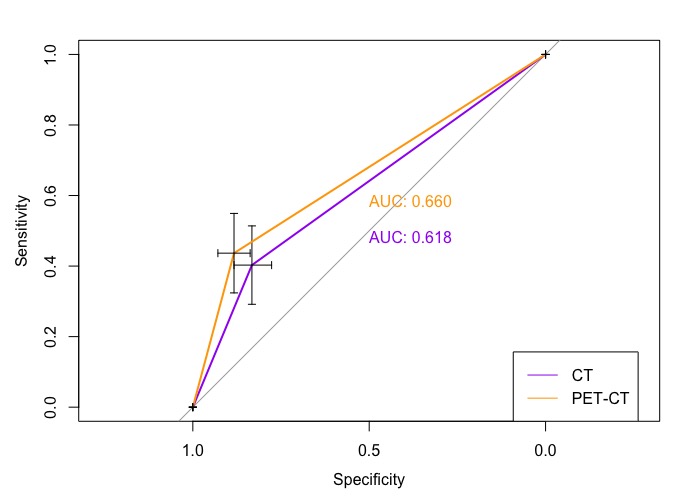
MP46-08: Diagnostic performance of PET-CT compared to conventional CT for lymph node staging in bladder cancer patients undergoing radical cystectomy and bilateral pelvic lymph node dissection
Introduction: Pre-operative lymph node (LN) staging has a pivotal role in the therapeutic pathway of bladder cancer (BC) patients undergoing radical cystectomy (RC) and bilateral pelvic lymph node dissection. Conventional imaging (i.e. CT-scan) has been proved to have low accuracy in LN staging. Therefore, we evaluated the diagnostic performance of of 18F-fluorodeoxyglucose positron emission tomography-computed tomography (FDG-PET-CT). Methods: 272 patients affected by BC who underwent RC between 2015 and 2022 in a high-volume center were retrospectively evaluated. Both pre-operative FDG-PET-scan and CT-scan were performed, evaluating pelvic LN invasion. All patients underwent pelvic lymph nodes dissection at RC. Sensitivity, specificity, positive (PPV), negative predictive value (NPV) and accuracy of both exams were determined with 95% CI, according to the presence of LN invasion at final histopathology reports obtained from RC. A sub-group analysis of patients who did not receive neoadjuvant chemotherapy (NAC) was also done. Results: Overall, 222 (85%) patients had pT2 diseased at last TURBT. Open and robot-assisted RC were performed in 34% (n=92) and 66% (n=179) of the cases respectively. LN invasion at final pathology report was found in 63 patients (23%). On a per-patient analysis, conventional CT had 40% [29-53] sensitivity, 83% [77-88] specificity, 47% [34-60] PPV, 79% [73-85] NPV, whereas the corresponding figures for FDG-PET-CT were 44% [32-56], 88% [83-92], 57% [43-71], 81% [75, 0.86]. Accuracy for conventional CT and FDG-PET-CT was respectively 72% [66-77] and 76% [71-81]. In NAC-naïve patients (n=112), conventional CT showed 27% [12-48] sensitivity, 88% [80-94] specificity, 37% [16-62] PPV, 82% [74-89] NPV, 75% [67-83] accuracy, whereas the corresponding figures for FDG-PET-CT were 23% [9-44], 92% [85-96], 43% [18-71], 82% [74-89], 78% [70-85]. Conclusions: Our study showed that FDG-PET-CT had a general better diagnostic performance compared to conventional CT, although having a lower sensitivity and similar NPV in chemo-naïve patients. Thus, FDG-PET-CT could improve the management of BC patients before RC. SOURCE OF Funding: None