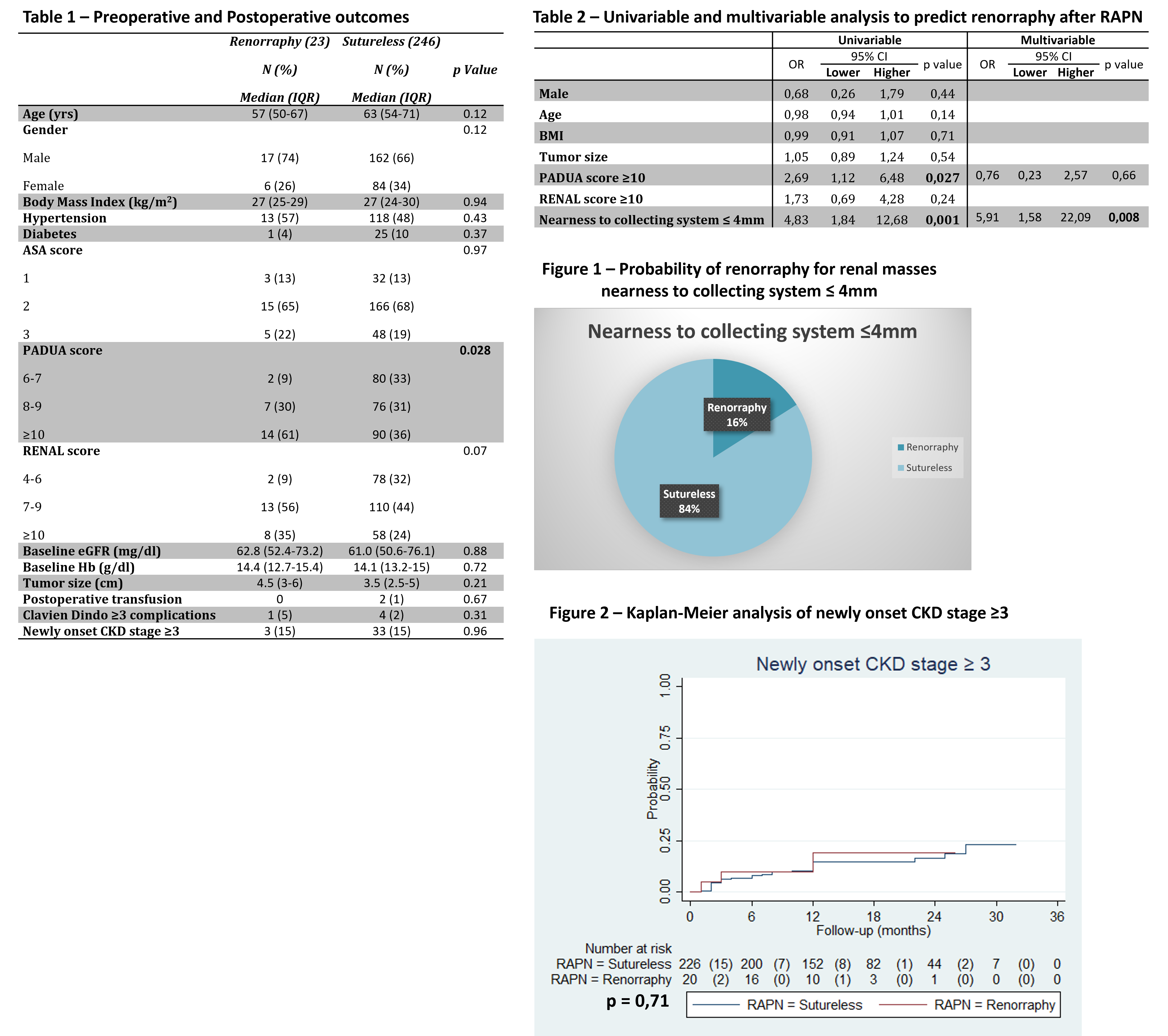
Introduction: Minimizing renal function loss during robot-assisted partial nephrectomy (RAPN) is a primary surgical outcome. There are few reports about sutureless RAPN and this procedure has intrinsic selection bias, being renorraphy a mandatory step to manage major bleeding sources and unintended urinary tract violation. The aim of this study was to describe predictors of performing renorraphy, and to compare perioperative and functional outcomes between sutureless and conventional renorraphy RAPN Methods: Our single center IRB approved renal cancer database was queried for “RAPN” and “renorraphy””. After a standardization process, all consecutive patients treated between Jan 2020 and May 2022 underwent off-clamp RAPN with a sutureless intent. Renal stump coagulation was used to control bleeding sources after RAPN. Intraoperative evidences of urinary tract violation was the only indication to perform renorraphy. Baseline and postoperative outcomes were collected. Continuous and categorical variables were compared using Mann-Whitney and Chi-Square tests. Logistic regression analysis was performed to identify predictors of renorraphy. Kaplan-Meier (KM) analysis and the log-rank test were performed to compare probabilities of developing newly onset chronic kidney disease (CKD) stage=3 between cohorts Results: Out of 269 patients included, sutureless approach was successully completed in 246 patients. Both cohorts were homogeneous for baseline features except for PADUA score (p=0.028). No differences occurred postoperatively (Tab 1). On multivariable analysis, nearness to collecting system =4mm was the only independent predictor of need for renorraphy (p=0.008 - Tab 2). Overall, 108 patients had a renal tumor nearness =4mm to collecting system and sutureless intent failure probability was 16%. At KM analysis, performing renorraphy did not impact on probabilities of developning CKD stage =3 (2yrs: sutureless: 16.3%±2.9 vs renorraphy: 19.0%±10.5; p=0.71) Conclusions: Nearness to urinary collecting system predicts probability of performing renorraphy, which had negligible impact on perioperative and early functional outcomes. Safety, feasibility and functional outcomes of sutureless RAPN were confirmed, even if larger cohorts and randomized controlled trials are needed to obtain stronger evidences SOURCE OF Funding: none